
Pricing Models for Venue Phone AI: Flat Fee, Per Minute, Per Order
Key Takeaways
- Compare the same job first. Answering a call and taking the order into the POS are different products.
- A flat fee stays put until you outgrow the tier. The surprise is the overage or the next tier.
- A meter grows with every billable minute. The surprise is long calls, hold time and spam.
- A per-order cut grows with orders and ticket size. A guest-paid phone order fee is the same model with a different payer.
- Good vendors disclose before you ask. Price, overage, billable minutes and any guest fee belong on the site.

How much does AI phone answering cost for a venue?
Published prices we checked in November 2026 start at $85 a month billed yearly for a plan that only answers calls, and at $220 a month billed yearly for one that takes phone orders into the POS. Compare plans that do the same job. Then compare the pricing model, because that decides what a busy month costs.
Last updated November 12, 2026. Vendor prices checked on each vendor's own pricing page on November 11, 2026.
Picture your phone on a slow Tuesday, then on the Saturday before holiday party season. Far more calls, and longer ones. One pricing model barely notices. Another bills every minute. A third takes a slice of every order. A fourth hands that slice to your guests.
TastyVox sells venue phone AI, so we have a stake in this topic. No vendor paid for or reviewed this article.
Are you comparing plans that do the same job?
An answering service that takes a message and an agent that places the order are different products. One tells the guest your hours or texts a link. The other takes the order on the call and sends it to the POS and KDS you already use.
Published plans show the gap. Maple's entry plan, Maple Voice, is described as voice and FAQ answering only, without ordering or reservations. Its Maple Pro plan lists "Take phone orders into your POS." Slang's Core and Premium plans center on reservations, and list texting guests "ordering links" rather than taking the order on the call.
Line up plans by job first. Only then compare prices.
What are the ways venue phone AI is priced?
Almost every plan is one of three models. A fourth, the phone order fee paid by the guest, is the per-order model with a different payer.
| Model | You pay for | Your bill rises when | Watch for |
|---|---|---|---|
| Flat monthly fee, tiered by minutes | A set number of call minutes | You pass the included minutes | Overage rate, tier jumps |
| Per-minute or per-call meter | Each billable minute or call | Any call comes in, spam included | What counts as billable |
| Commission or per-order cut | A fee or percentage per order | The phone takes more orders, or bigger ones | A percentage on catering orders |
| Guest-paid phone order fee | Little or nothing, if guests cover it | Guests pay more as orders grow | Lost orders, tips and goodwill |
How does a flat monthly fee behave as a venue gets busier?
A flat fee stays the same from a quiet week to a packed one, as long as you stay inside the included minutes. You can budget it like rent.
The surprise sits at the edge of the tier. When a holiday month pushes you past the included minutes, you pay an overage rate on each extra minute, or the plan moves you up a tier. Either way the bill steps up, and you find out on the invoice.
The quieter cost is unused minutes. In a slow month you still pay for the whole tier.
How does per-minute or per-call billing behave as a venue gets busier?
A meter starts near zero and climbs with every billable minute. In a slow month it is often the cheapest option. In a busy month it keeps climbing, with no ceiling.
The surprise is in what the meter counts. Busy months bring longer calls: party questions, menu walk-throughs, changed minds. Spam and wrong numbers can be billable too. So can the time a guest waits on hold during a transfer to a staff member.
Per-call pricing has the same shape. A short hours question costs as much as a long party inquiry.
How does a per-order cut behave as a venue gets busier?
A per-order model charges a fixed fee or a percentage each time the phone takes an order. Bite Buddy, a phone AI vendor, says on its own blog that "a typical rate is around $1.50 per completed order." That is a vendor's statement, not an industry benchmark.
The cost grows with your success. More phone orders means a bigger fee. A percentage cut also grows with ticket size, so the surprise is the big catering order.
Delivery-app commissions have the same shape. Our phone ordering vs delivery apps breakdown walks through the math.
What about a phone order fee paid by the guest?
Some vendors suggest passing the cost to the guest. The same Bite Buddy post says "Many restaurants offset the AI cost entirely by adding a small phone order fee to orders placed through the AI system," and that "A $1.50 phone order fee applied to each completed AI order effectively reduces the net cost to $0 on a per-order model." That is the vendor's own claim, published May 1, 2026.
Our view: this is the per-order model with a different payer. It is still a price per outcome. The bill still grows with every order. It just lands on the guest's check instead of your invoice.
That does not make it free. A caller who hears about a fee may hang up and order elsewhere. A guest who sees it on the check may tip less. Those costs never show up on an invoice.
If a vendor suggests a guest fee, ask
- Who sets the fee, you or the vendor?
- Is it disclosed to the caller before they pay?
- Does the vendor keep all of it?
- What happens to the fee on a refund or a remake?
- Is it allowed where you operate? Rules on fee disclosure vary by state and city, so check your local rules first.
Where does the surprise bill come from in each model?
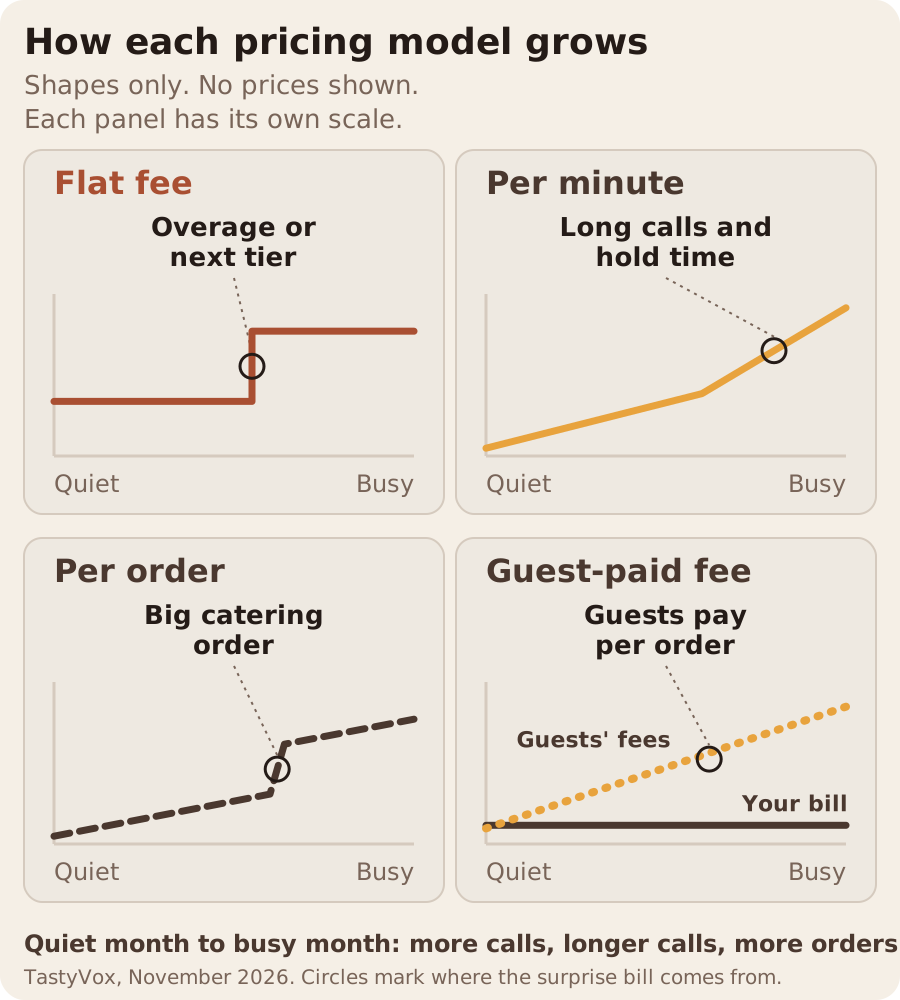
| Model | What stays fixed | What grows as you get busier | Where the surprise comes from |
|---|---|---|---|
| Flat fee | The monthly price, up to the included minutes | Nothing, until you pass the tier | Overage rate or a forced jump to the next tier |
| Per minute or per call | Nothing | Every billable minute or call | Long calls, hold time during transfers, spam |
| Per order | Nothing, or a small base | Order count, and ticket size on a percentage | A big catering order or a strong month of phone orders |
| Guest-paid fee | Your invoice, if guests cover the cost | The fee total on guests' checks | Lost orders, smaller tips and goodwill |
Which pricing model suits which venue?
- Flat fee: steady or growing call volume, one number to budget, and many phone orders.
- Per minute or per call: low or seasonal volume, short calls, and most months quiet.
- Per order: most calls are questions, phone orders are few, and catering is rare.
- Guest-paid fee: only if your guests already accept fees, you disclose it up front, and local rules allow it.
Not sure which you are? Pull one month of call logs: calls, average length, orders. Ask each vendor to price that month and your busiest month in writing.
What should you ask any phone AI vendor before you sign?
- What job does this plan do? Does it take the order on the call and send it to the POS, or take a message or text a link?
- What is the overage rate, in dollars per minute? Does the plan move me up a tier on its own, or ask first?
- Is there a setup or onboarding fee? Is it refundable if we stop in the first month?
- Is pricing per location? What does a second location cost, and when does group pricing start?
- How long is the contract? What does it cost to leave early?
- What counts as a billable minute or call? Spam, hang-ups, hold time during transfers, and rounding per call.
- Is order-taking in the price I am quoted? Or is it a higher tier, an add-on, or a per-order fee on top?
- Who holds the phone number and the AI accounts? Will separate carrier or AI bills show up?
Get the answers in writing. To count the full cost of a trial, including staff review time, use our venue voice AI pilot scorecard.
What does good pricing disclosure look like?
You should not need a sales call to learn what a phone line costs. Good disclosure means:
- The price is on the site. Not "shown after a form."
- Per-location terms are stated.
- The overage rate is stated, in dollars, next to the plan.
- Billable minutes are defined. Spam, hang-ups, transfers and rounding are spelled out.
- Order-taking is not a surprise add-on. If it costs more, the plan says so.
- Any guest fee is disclosed. Who sets it, who keeps it, and when the caller hears about it.
What do published venue phone AI prices look like right now?
Prices below are copied from each vendor's own pricing page, checked November 11, 2026.
| Plan | Model on its pricing page | Published price | Takes food orders on the call? |
|---|---|---|---|
| Maple Voice | Flat monthly, "No per-minute fees" | $150 a month, or $85 a month billed yearly | No |
| Maple Pro | Flat monthly, "No per-minute fees" | $350 a month, or $220 a month billed yearly | Yes |
| Slang Core | Per location, starting price | From $399 per location | No, texts an ordering link |
| Slang Premium | Per location, starting price | From $599 per location | No, texts an ordering link |
Slang's page does not state included minutes or an overage rate. On the same date, Kea and Hostie showed no dollar figure on their pricing pages, and Popmenu listed AI answering as an add-on without a price.
Where does TastyVox stand on pricing?
TastyVox pricing starts at $99 per location. Multi-location groups get custom pricing. There is no commission and no per-order cut.
Want a second opinion on a quote? Book a fit call and bring one month of call logs.
How this was researched
Vendor prices were read on each vendor's own pricing page on November 11, 2026, and are linked where they appear. Statements about per-order rates and guest phone order fees are quoted from a vendor's own blog and labeled as that vendor's claim. The diagram shows the shape of each pricing model, not prices. TastyVox sells venue phone AI. No vendor paid for or reviewed this article.
Want to hear what this sounds like in practice?
Listen to a demo call with a real restaurant menu. No commitment, no sales pitch.
Frequently asked questions
How much does AI phone answering cost for a restaurant or venue?
Published plans checked in November 2026 start at $85 a month billed yearly for answering only, and $220 a month billed yearly for taking phone orders into the POS. The pricing model then decides your busy-month bill.
Is per-minute pricing cheaper than a flat monthly fee?
In a quiet month, often yes. In a busy month a meter keeps climbing while a flat fee holds. Compare both on your busiest month.
Should I add a phone order fee to cover the AI cost?
It moves the cost, it does not remove it. The per-order price lands on the guest's check, where it can cost you orders, tips or goodwill. Disclose it before the guest pays, and check your local rules on fees.
Do I pay separately for each location?
Often. Slang's published prices, for example, are per location. Ask what a second location costs before you sign.
See how TastyVox sounds with your menu.
Book a 20-minute call and we'll walk through how it works for your specific restaurant.