
AI Phone Answering for Activity Venues: Bookings, Parties and Food Orders on One Line
Key Takeaways
- No single call type owns the line. At TastyVox venues, food orders and questions were the most common reasons for calling, at similar volume. Booking and group calls came next.
- Ask what leaves the call. A ticket in the kitchen, a booking in your system, a proposal for your team. An answer alone does not move a guest forward.
- A good agent books inside your rules. It never tells a caller a time is theirs until your booking system has accepted it.
- The agent does the prep. Your team approves. On party calls, a good agent drafts the proposal and follows up. Judgment calls still belong to a person.
What does AI phone answering do for an activity venue?
AI phone answering for an activity venue answers the calls your team can't reach and sorts each one by what the caller needs. Food orders go into your kitchen. Bookings get made under the rules you set. Party inquiries reach your team as a proposal ready to approve. Anyone who needs a person gets a warm transfer.
Picture a Friday, a little before 6pm. The host is checking in a group of 16 for their lane time. The phone rings three times in ten minutes.
The first caller wants 20 wings and two baskets of fries for pickup. The second wants to know if a group of 12 can get lanes on Saturday night. The third is planning her son's birthday: how many kids, what ages, is pizza included, can the parents play too.
A restaurant phone tool can handle the first call. A booking widget handles none of them, because these people are on the phone, not on your website. And the one person who could help is holding a stack of waivers.
This guide is for owners and GMs of axe throwing bars, bowling centers, golf simulator lounges, pickleball and sports clubs, arcades, family entertainment centers, theatres, multi-activity venues, and breweries or bars with an activity and a kitchen. TastyVox, which publishes it, builds phone agents for hospitality venues.
What do callers actually ask for?
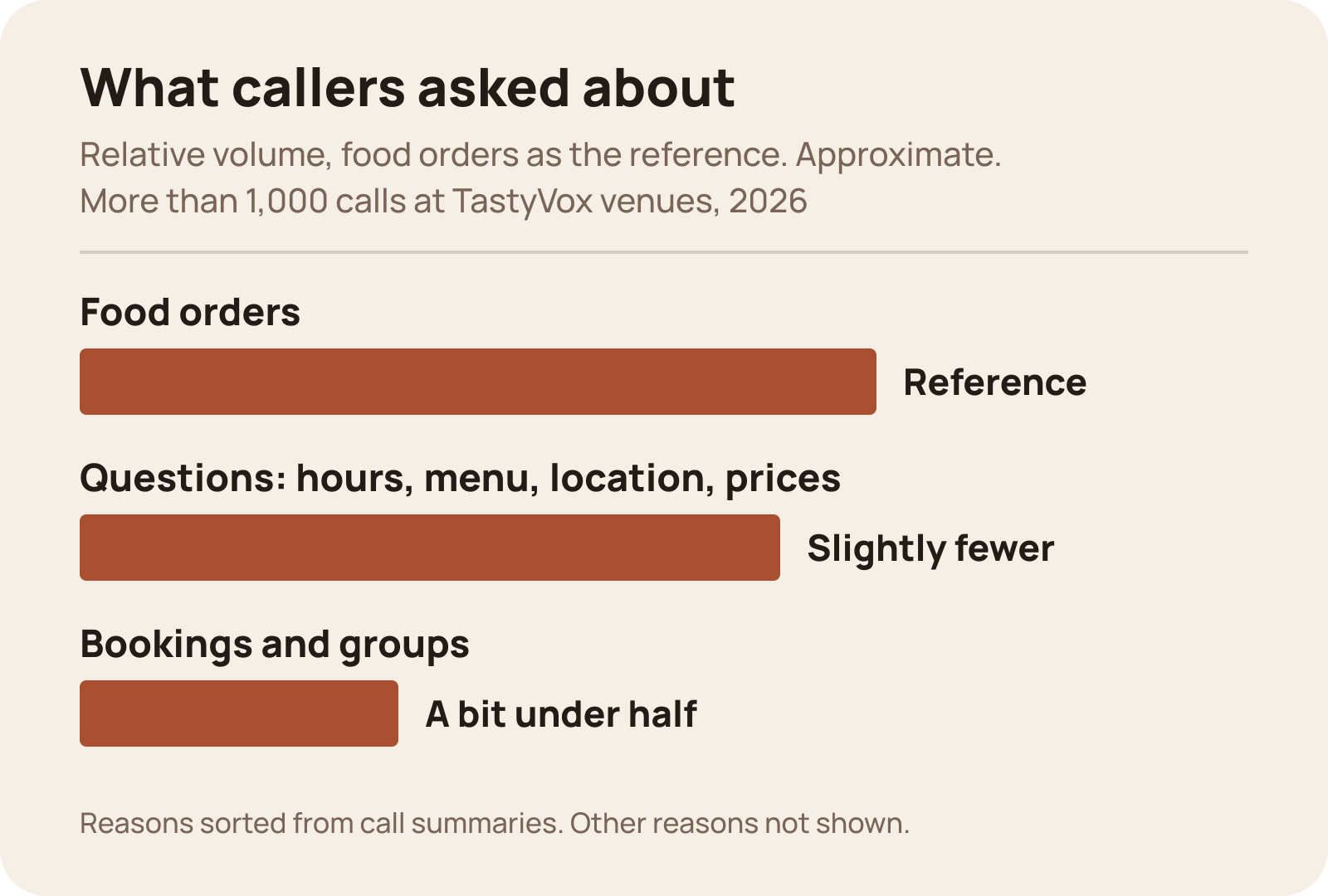
We looked at more than 1,000 calls at TastyVox venues in 2026. The reasons were sorted from call summaries, so treat what follows as approximate.
Food orders and questions about hours, menu, location and prices were the two most common reasons callers gave, at similar volume. Booking and group calls came next, at a bit under half the volume of either.
How many calls turn into orders depends on the venue. On a takeout-heavy kitchen line, most calls are orders. Where food is a second revenue line beside an activity, orders are one call type among several.
About 1 in 5 calls lasted only a few seconds: hang-ups, misdials and silence. Count those short calls separately when you judge any phone tool. Otherwise every hang-up looks like a missed sale.
Across TastyVox venues, Friday was the busiest day. Calls peaked from late morning to noon and stayed heavy into the early evening. At an activity venue, that early evening stretch is when the host is checking in groups and the kitchen is filling up.
The lesson is simple. A tool built only for orders, only for bookings or only for questions misses much of what comes in.
Why does an activity venue's phone line have more jobs to do than a restaurant's?
A restaurant phone mostly carries takeout orders and table questions. An activity venue carries at least five kinds of work.
- Mixed calls on one line. Food, lane or bay time, parties, leagues, lost phones and "are you open" all come in on the same number.
- Time slots, not tables. A lane, bay, court or throwing pit is sold in blocks of time. A group of 12 at 8pm Saturday may need several at once.
- Parties need qualifying. A birthday or company outing comes with a date, headcount, ages, a package and food. Those details decide whether it fits.
- Waivers and age rules. Callers ask about minimum ages, shoe rules and waivers all the time. The answer has to be your rule, exactly as you wrote it.
- Food is a second revenue line. Wings, pizza and pitchers are real money. A phone order should land in the kitchen like any other ticket.
This is why a restaurant phone tool covers only part of the line here. It can take the wings order. It has no idea what a bay is.
What should a good phone agent do with each type of call?
Each call type needs a different outcome.
Food orders
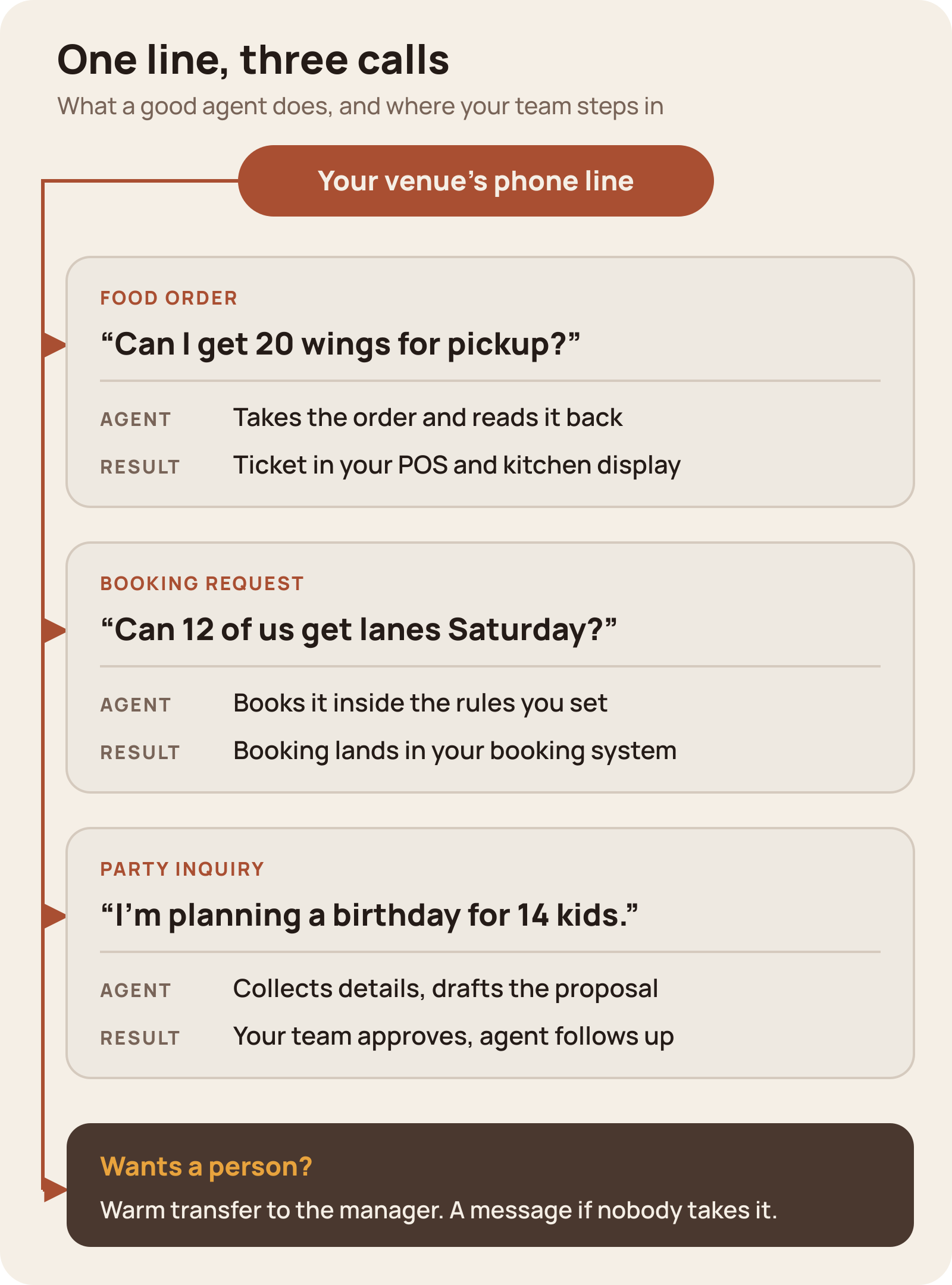
A good agent takes the full order, reads it back, and sends it into the POS and kitchen display you already use. Nobody re-keys it. Test it with your hardest item, like the platter with three sauces and a swap. Our guide to menus and modifiers on phone orders shows what to try.
Booking requests
A good agent makes the booking itself, inside rules you have approved: which activities, which times, what group sizes and what deposit it may take. It keeps your booking system as the one source of truth. It never tells a caller a time is theirs until that system has accepted it. This matters most on a busy Saturday, when two callers want the same 8pm bay.
When a request falls outside your rules, like a bigger group or a time you hold back, it texts the caller your booking link or turns the call into a group inquiry. Either way, the caller is never left at a dead end.
Party and event inquiries
Capturing details is the low bar. A good agent collects the date, headcount, ages, package interest and a callback number, then drafts the proposal from your packages and prices: package, food, timing and a price estimate. Your team gets a proposal ready to approve, edit or decline, not a note to decode. Once approved, the agent sends it and follows up with the caller.
It sorts inquiries by urgency, so a party next weekend does not wait behind one next spring. It never promises a date or price your team has not approved. Our guide to holiday party and group booking calls lists the details worth capturing.
Questions
Hours, menu, prices, age rules, waiver rules, what to wear. A good agent answers from the information you give it, word for word on rules. If the answer is not there, it says so and offers a person. A confident wrong answer about age limits is worse than no answer, because the family finds out at the door.
| Call type | What a good agent does | When a person steps in |
|---|---|---|
| Food order | Takes the order, reads it back, sends it to your POS and kitchen display | Allergy questions the menu does not answer, complaints about an order |
| Lane, bay or court booking | Books it inside the rules you set; texts your booking link if the request falls outside them | Groups above your limit, special requests, anything outside your rules |
| Party or event inquiry | Collects details, drafts the proposal, follows up once approved | Approving the proposal, package changes, anything outside your rules |
| Question (hours, menu, prices, rules) | Answers from the information you provide | Anything not in your information, or a rule that needs judgment |
When should any phone agent hand the call to a person?
Some calls need a person, however good the agent is
- Complaints. An unhappy guest wants to be heard by someone who can fix it.
- Injuries or safety. Anything about someone getting hurt goes to a manager at once.
- Unusual events. Buyouts, private takeovers and requests your packages do not cover.
- Manager discretion. Refunds, exceptions to house rules, and allergy questions your menu does not settle.
The handoff itself matters. A good agent uses a warm transfer: it asks the manager whether they can take the call before connecting. If nobody picks up, it takes a message with the details, so the caller does not repeat themselves. Decide in advance who reads those messages, and how fast. A message nobody owns is still a dead end. Our human handoff guide covers how to test this.
What should you check before buying a phone agent for an activity venue?
A demo with your own calls tells you more than any product page. Bring these questions.
- Does it take actions or only answer questions? Ask what leaves the call: a kitchen ticket, a booking, a draft proposal, a page to your manager.
- How does it hand off? Put the manager's phone on silent during the demo. Does the caller get a message option, or a dead end?
- How does it handle parties? Call as a party of 14 with kids under 10. See what it asks, and whether your team gets a proposal or just a message.
- Do food orders land in the kitchen flow? Watch a test order reach the kitchen screen. A transcript is not a ticket.
- Does it say what it cannot do? Ask exactly which bookings it can make, which deposits it can take, and what happens outside your rules. A clear "not yet" beats a demo that implies yes.
- What is the pricing model? Flat fee, per minute, per order or a share of each sale. A per-order cut grows with your best nights.
- Will it run on your real calls? Use your menu, packages and rules. Our pilot scorecard lays out a 30-day test.
Want to see this on your own calls?
TastyVox is the Revenue Desk for hospitality venues. Pricing starts at $99 per location.
See our activity venues page, or book a fit call and bring your menu, packages and house rules.
Last updated: November 17, 2026.
How this was researched
This guide uses TastyVox's own call data: more than 1,000 calls answered at TastyVox venues in 2026. Call reasons were sorted from call summaries and all comparisons are approximate. Descriptions of what a phone agent should do are editorial guidance on good practice, not claims about any specific product. No outside statistics are used.
Want to hear what this sounds like in practice?
Listen to a demo call with a real restaurant menu. No commitment, no sales pitch.
Frequently asked questions
Can an AI phone agent book lanes, bays or courts?
A good one can. It books inside the rules you set: which activities, times, group sizes and deposits it may handle. Your booking system stays the source of truth, and the agent never tells a caller a time is theirs until that system has accepted it. Requests outside your rules get your booking link by text or go to your team.
Can it handle birthday party and group inquiries?
A good agent collects the party details, drafts a proposal from your packages and prices, and gives your team a proposal to approve, edit or decline. Once approved, it sends the proposal to the caller and follows up.
Can it take food orders at a bowling alley or axe throwing bar?
A good one can, if the venue serves food. It takes the full order, reads it back and sends it into the POS and kitchen display already in use. Ask to see a test ticket reach the kitchen.
When should a phone agent hand a call to a person?
Complaints, injuries or safety issues, unusual events like buyouts, and anything that needs a manager's discretion. A good agent asks the manager before transferring, and takes a full message if nobody picks up.
How is AI phone answering priced?
Models vary: a flat monthly fee, per-minute charges, per-order fees or a share of sales. Per-order fees grow with your busiest nights. Ask for the total cost of a normal month and a busy one.
Does AI phone answering work for theatres, family entertainment centers and other activity venues?
The pattern holds. At a theatre, a family entertainment center, a golf simulator lounge or a pickleball club, the same three call types show up: tickets or bookings, groups and parties, and concessions or food. What changes is the booking or ticketing system and the venue's rules, like age limits, capacity and refund terms. A good agent answers questions, books inside the venue's rules, drafts proposals for groups and hands off to a person.
See how TastyVox sounds with your menu.
Book a 20-minute call and we'll walk through how it works for your specific restaurant.