
Catering Calls: How a Good Phone Agent Turns an Inquiry Into a Quote
Key Takeaways
- Catering is food leaving your venue, at volume, on a deadline. Treat the call as a sale, not a message.
- Eight details decide the quote. Get them all on the first call, and read back the address and any allergy.
- Check before you promise. Minimums, lead times and delivery zone come before any price.
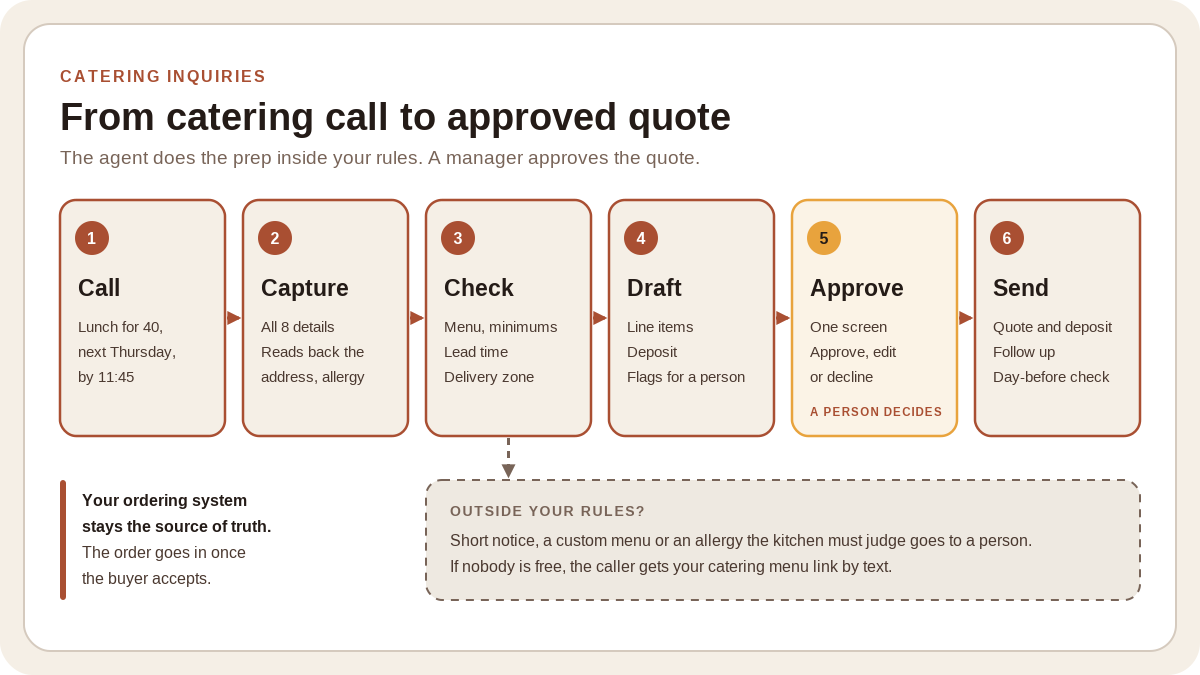
- A good phone agent drafts the quote. A manager approves it. Then the agent sends it and follows up.
How should a venue handle a catering order by phone?
Catering calls often go to the venue that sends a clear quote first. Capture the details that decide the price, check them against your catering menu, minimums and lead times, and put a draft quote in front of a manager the same day. Once it is approved, send it, take the deposit if your terms allow, and follow up.
Tuesday, 2pm: lunch for 40 next Thursday
The phone rings at 2pm on a Tuesday. The kitchen is still working through late lunch tickets. The manager is off until tomorrow.
"Hi, I need lunch for 40 next Thursday. Three vegetarians, one nut allergy. It has to be there by 11:45."
Whoever picks up writes "cater 40, Thurs, nut" and a number on a pad. A ticket prints. The pad goes under the register.
Wednesday, the manager finds it, maybe. Which Thursday? Delivered where? Who is paying? They call back. Voicemail. By the time they connect, the office manager has a quote from someone else.
Nobody did anything wrong. The person who answered was cooking. Nobody told them what a catering note needs to say.
One catering order can be worth a busy shift of takeout. And the work is moving out the door. The National Restaurant Association's 2025 off-premises research found that nearly 75% of restaurant traffic now happens off-premises. Most of that is takeout and delivery, not catering. But operators see the opening: in a May 2026 Citizens survey of multi-unit franchise operators, expanding catering and off-premise was the top growth priority for 2026.
Our holiday party guide covered groups coming to your venue. This one is about food leaving it.
Why is a catering call harder than a takeout order?
A takeout order is ready in minutes and paid at the counter. A catering order is a small project with someone else's deadline.
| Takeout order | Catering inquiry | |
|---|---|---|
| When it is due | Tonight, in minutes | Days out, to the minute |
| Size | One to six people | Ten to a few hundred |
| Where it goes | Your counter | An office, a site, a floor with a check-in desk |
| Allergies | One guest at a time | Several guests, packed and labeled apart |
| Who pays | The caller | Often a company, by card or invoice |
| Who signs off | Nobody | A manager, against your rules |
Every row is a place the order can go wrong, and a question to ask on the first call.
What details decide a catering quote?
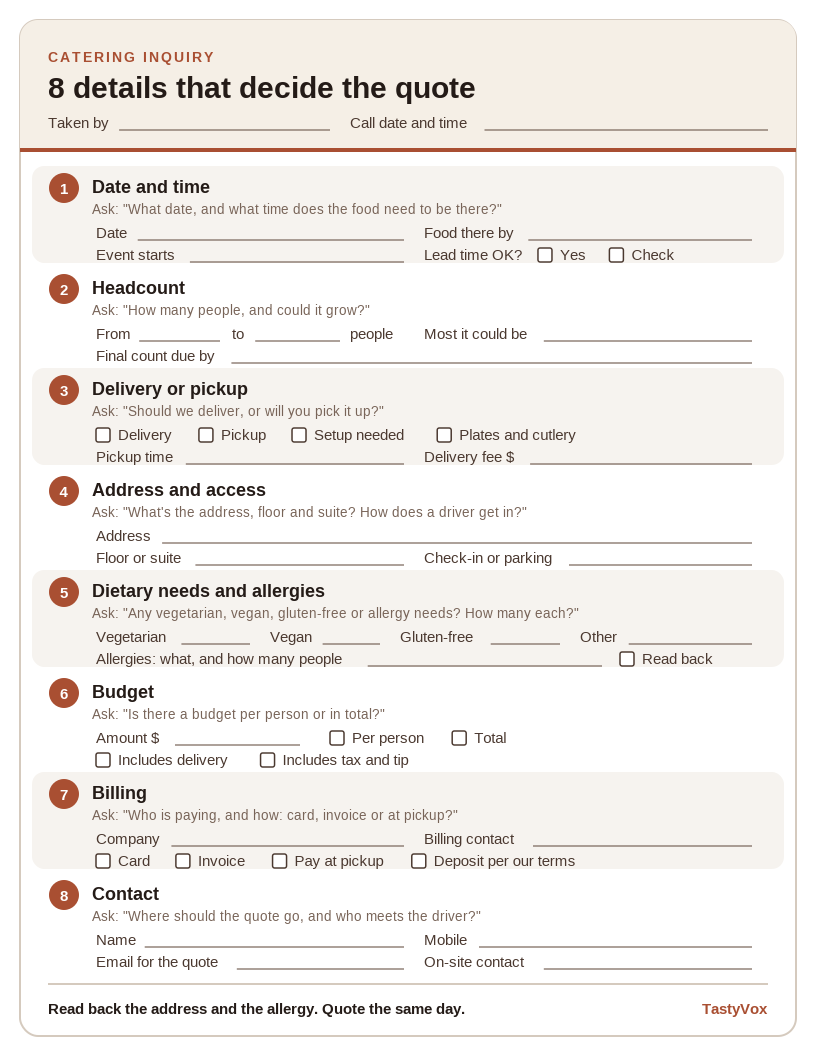
Eight details. Get them all and a manager can price the order without calling back.
| Detail | Ask | Why it changes the quote |
|---|---|---|
| 1. Date and time | "What date, and what time does the food need to be there?" | Lead time, kitchen load, delivery slot |
| 2. Headcount | "How many people, and could it grow?" | Portions, trays, minimums |
| 3. Delivery or pickup | "Should we deliver, or will you pick it up?" | Delivery fee, driver, setup |
| 4. Address and access | "What's the address, floor and suite? How does a driver get in?" | Delivery zone, timing, parking |
| 5. Dietary needs | "Any vegetarian, vegan, gluten-free or allergy needs? How many each?" | Menu, packaging, kitchen sign-off |
| 6. Budget | "Is there a budget per person or in total?" | Which package you offer |
| 7. Billing | "Who is paying, and how: card, invoice or at pickup?" | Deposit, paperwork, receipt name |
| 8. Contact | "Where should the quote go, and who meets the driver?" | Who approves, who meets the driver |
Read two of these back on every call: the address, including the floor, and the allergy. "So that's one guest with a nut allergy, packed on its own?" A wrong address ruins the drop. A wrong allergy is a safety problem.
What should you check before you quote?
The details say what the caller wants. Your rules say what you can promise. Check these before anyone mentions a price.
- Catering menu. Quote from your packages and trays, not the dine-in menu.
- Minimums. An order minimum, a delivery minimum, or both.
- Lead time. How much notice you need for this size of order.
- Delivery zone and fee. Is the address inside it, and what does it cost?
- Kitchen load. What else goes out that morning?
- Allergy limits. What your kitchen can promise, and what it cannot.
Say your rule is 48 hours' notice for orders over 25. The Tuesday call for next Thursday clears it. The same call on Wednesday afternoon, for Thursday, does not. A good answer is still useful: "We can't do a full spread for 40 by then. We can do boxed lunches for pickup at 11, or I can ask our catering lead."
What does a quote ready to approve look like?
Not a note to decode. A draft a manager can approve in a minute. Here is one for the Tuesday call, with made-up prices.
| Quote ready to approve | Office lunch for 40 |
|---|---|
| When | Next Thursday, delivered by 11:45 |
| Where | Office address, 4th floor. Driver checks in at the front desk. |
| Menu | Chicken bowl bar for 36. Roasted vegetable bowls for 3. One nut-free boxed lunch, packed and labeled on its own. |
| Extras | Plates, cutlery and napkins. Drop-off setup. |
| Price | 40 people at $17 is $680, plus $45 delivery. $725 before tax. |
| Deposit | 25% under your catering terms: $181.25 |
| Rules check | Nine days' notice: OK. Over the 20-person minimum. Inside the delivery zone. |
| Flags | Kitchen to confirm the bowl sauces are nut-free. One other catering order goes out at 11:00 Thursday. |
| Your call | Approve and send, edit, or decline |
The manager checks the sauce with the kitchen and approves. Whoever answered the phone never had to think about it.
How do you tell if an AI phone agent can handle catering?
Most phone agents can take a message. Fewer can take a catering call from inquiry to a quote your manager can approve. Before you sign with anyone, ask these six questions. Then have them run a call like the Tuesday one above and look at what lands in front of your manager.
"What does it do when the caller says 'around 40, maybe a couple more'?" You want to hear that it asks for the ceiling and moves on. If the caller ends up filling in a form, keep looking.
"Where do my catering rules live, and what happens when an order breaks one?" Menu, minimums, lead time, delivery zone. Ask to hear a call where the order did not fit. A good agent says so on the call and offers what does fit. A weak one takes the order and leaves the problem for your manager.
"Can it draft the quote from my catering menu and prices?" Ask for a sample. Look for line items, delivery, the deposit, and flags for anything a person must settle. A transcript or a "call this person back" note is not a quote.
"What does my manager see, and who says yes?" It should be one screen: approve, edit or decline. Nothing reaches the customer until your manager approves it.
"What happens after approval?" Ask who sends the quote, who takes the deposit, and how the order gets into your ordering system. Your system should stay the one source of truth. Ask whether it follows up when the buyer goes quiet, and whether it checks the headcount and on-site contact the day before.
"When does it bring in a person?" Custom menus, very large events, allergy judgment calls, complaints and refunds should go to a person, with the details written down. See our guide to handing a call to a person. If the answer to every hard case is "it texts your menu link," you are looking at a message taker, not a catering agent.
Comparing phone agents for food and catering orders? Take these questions into the demo.
What can you do about catering calls this week?
You can fix most of this by hand before next Tuesday.
- Write your catering rules on one page. Minimums, lead times, delivery zone and fee, deposit terms, and the cutoff for headcount changes.
- Print the intake card. One by every phone.
- Price three or four packages per person. Quoting a package is faster than building a menu on every call.
- Pick one place every catering inquiry goes. One inbox or one clipboard. Not a pad under the register.
- Set a quote standard. Same business day is a fair goal.
- Count for a month. Inquiries, quotes sent, hours to quote, orders won.
When you are ready to compare phone agents, TastyVox pricing starts at $99 per location. Multi-location groups get custom pricing. There is no commission and no per-order cut. To hear a catering call like this one, book a fit call.
Last updated: November 22, 2026.
How this was researched
This guide draws on how catering inquiries reach venues by phone, one National Restaurant Association study on off-premises dining and one operator survey. The eight details, the quote example, the phone-agent standard and the checklist are editorial guidance, not results from customer data. Prices in the quote example are made up for illustration.
Want to hear what this sounds like in practice?
Listen to a demo call with a real restaurant menu. No commitment, no sales pitch.
Frequently asked questions
What should I ask on a catering phone call?
Eight things: the date and the time food must arrive, the headcount, delivery or pickup, the address and how a driver gets in, dietary needs and allergies with counts, the budget, who is paying and how, and where the quote should go.
How much lead time should a catering order need?
That is your call, based on your kitchen and staff. Set it by order size, write it down, and say it on the first call. If a request is too short-notice, offer what you can do instead of a flat no.
Should we take a deposit on catering orders?
Many venues do for larger orders. Set your own terms: when a deposit applies, how much, and what happens on a cancellation. Rules on payments and cancellations vary by place, so check yours.
Can an AI phone agent quote catering orders?
A good one drafts the quote from your catering menu, prices and rules, then hands it to a manager to approve, edit or decline. After approval it sends the quote, takes the deposit if your terms allow, and follows up. Custom menus and allergy judgment calls go to a person.
See how TastyVox sounds with your menu.
Book a 20-minute call and we'll walk through how it works for your specific restaurant.