
Phone Answering for Franchise and Multi-Location Groups: Same Brand, Local Answers
Key Takeaways
- One standard, local truth. Brand voice, allergy and refund answers are set once. Hours, menus, prices and 86'd items are set per location.
- Route before you answer. A good agent knows which location the caller means before it quotes a price or a time.
- Write down who owns what. The franchisor sets the standard. Each franchisee keeps its local facts current.
- Pilot one or two locations, measure, then expand in waves.
What should phone answering do for a franchise or multi-location group?
A multi-location group needs its phones to follow one standard and know local truth. Brand voice, allergy answers and refund policy should be the same at every location. Hours, menus, prices and 86'd items should be exact for the location the caller is talking to. A good AI phone agent keeps both, routes each call to the right location, and reports per location and for the whole group.
Picture three calls on one Tuesday.
A caller rings the downtown location and asks for the brisket bao. Only the airport location sells it. The person who answers says "we don't have that" and the caller hangs up.
A second caller wants a table for six on Monday at the Eastside location. Eastside is closed on Mondays. Nobody offers the location ten minutes away that is open.
A third caller asks whether the fries share a fryer with the shrimp. At one location the answer is "yes, avoid them." At another it is "should be fine." Same brand, same question, two answers.
None of these is a disaster on its own. Across 12 locations and a year of calls, they add up.
Why does the same question get different answers at different locations?
Three things drift between locations: what is on the menu, when the doors are open, and who picks up the phone.
Menus drift by design. A location in an airport or a stadium sells a shorter menu. A new location tests a dish. A kitchen runs out and 86's an item at 7pm. Hours drift too: holiday closures, a Monday closing, a private event that shuts the patio.
People drift most. Training reaches some staff and not others. In a CDC study of 278 dining venues in six US sites, published in 2017, only a third of servers had received food allergy training at their current job. A phone answered by whoever is free inherits that gap.
For franchise groups, this is a portfolio problem, not a single-store one. The 2026 Franchising Economic Outlook from the International Franchise Association and FRANdata reports that 19.3% of franchisees run more than one unit, and together they control 58.8% of franchised locations. Most franchise phones sit inside a group that wants the same answer everywhere.
What should be the same everywhere, and what should be local?
Split every setting into two layers. The brand layer is set once and applies to every location. The location layer is owned by each location and kept current.
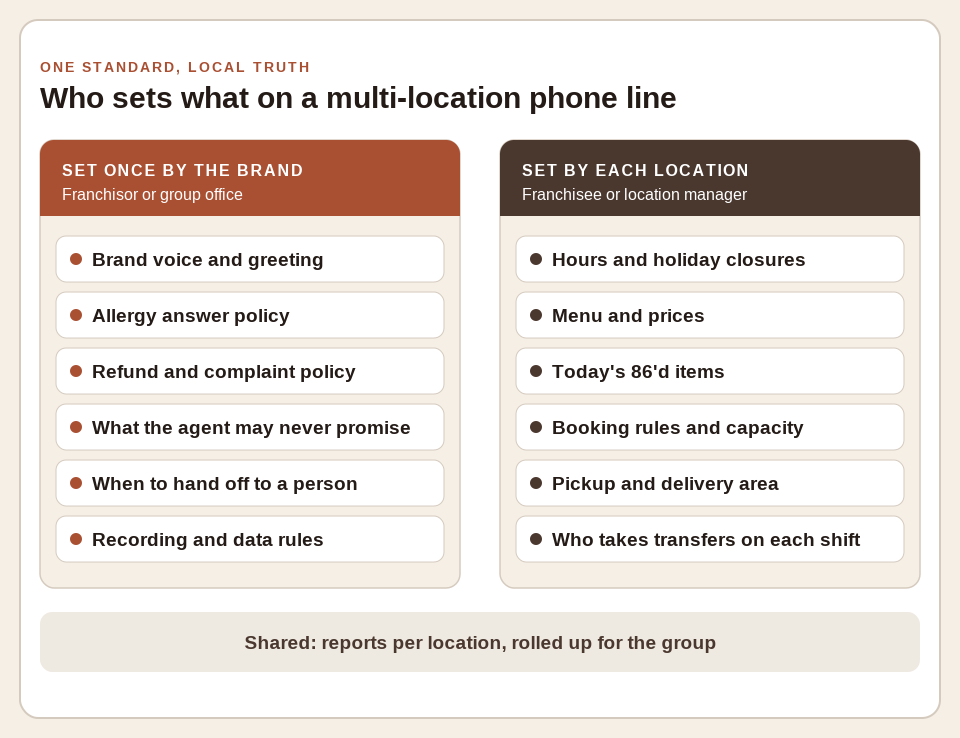
| Setting | Brand level or location level | Why |
|---|---|---|
| Voice, greeting and tone | Brand | Callers should hear the same brand at every door |
| Allergy answer policy | Brand | One safe way to answer, everywhere |
| Refund and complaint policy | Brand | A person decides, by the same rules |
| Hours, closures, holiday hours | Location | Each location keeps its own |
| Menu, prices and 86'd items | Location | Local menus and today's stock differ |
| Booking rules and capacity | Location | Rooms, tables and bays differ |
| Who takes transfers | Location | The manager on shift, not a head office line |
Allergy answers need one source, not one script
Allergy questions are where consistency matters most. A good agent answers only from a written allergen source for each item, owned by the brand. If a location uses a different supplier or fryer setup, that location's entry says so. If the answer is not written down, the agent says it cannot confirm and offers a person. It never guesses, and it never says "should be fine."
Rules on allergen disclosure vary by place. Check what applies where each location operates.
How should a good agent route calls to the right location?
Routing is where multi-location phone answering succeeds or fails. A good agent should:
- Answer as the location that was called. The greeting names it. The hours, menu and prices are that location's.
- Know what the other locations offer. When the downtown caller asks for the brisket bao, it says the airport location sells it, and offers to take the order there under that location's rules.
- Offer an open alternative. When Eastside is closed on Monday, it offers the nearest open location and makes the booking there if the caller agrees.
- Ask which location on a shared number. If the brand has one central number, the agent asks by neighborhood or cross street before quoting anything.
- Never mix locations. It never quotes one location's price, hours or availability as if it were another's.
Each order or booking lands in that location's own POS, kitchen screen or booking system. Those systems stay the one source of truth. Our guide to integrations and the source of truth covers what to check.
Who controls what: franchisor or franchisee?
Settle this in writing before the first call goes live. Your franchise agreement may already decide who picks vendors and who pays, so read it first.
A workable split
- The franchisor sets the standard. Brand voice, the allergy and refund policy, what the agent may never promise, handoff rules, and what reports roll up.
- Each franchisee keeps local truth current. Hours, menu availability, prices where they are allowed to vary, the 86 list, booking rules and who takes transfers on each shift.
- Both agree on access. Who can hear call recordings, who sees which numbers, and what happens to the setup if a location changes owner.
Complaints, refunds, safety issues and exceptions go to a person at the location, by warm transfer or a full message. Our guide to transfers to a person shows how to test that.
What should each location and the group see?
Each location should see its own calls, with the outcome of each: order placed, booking made, quote drafted, transferred, or message taken. It should also see the questions the agent could not answer, so the local manager can fill the gap.
The group should see the same numbers side by side, plus a few consistency checks: allergy questions answered from the written source, calls sent to another location, and transfers by location. A location with twice the transfers of its peers is worth a look. The cause may be a setup gap, like wrong hours or a missing menu item, rather than the team.
How should a multi-location group roll out a phone agent?
Start small, measure, then expand in waves.
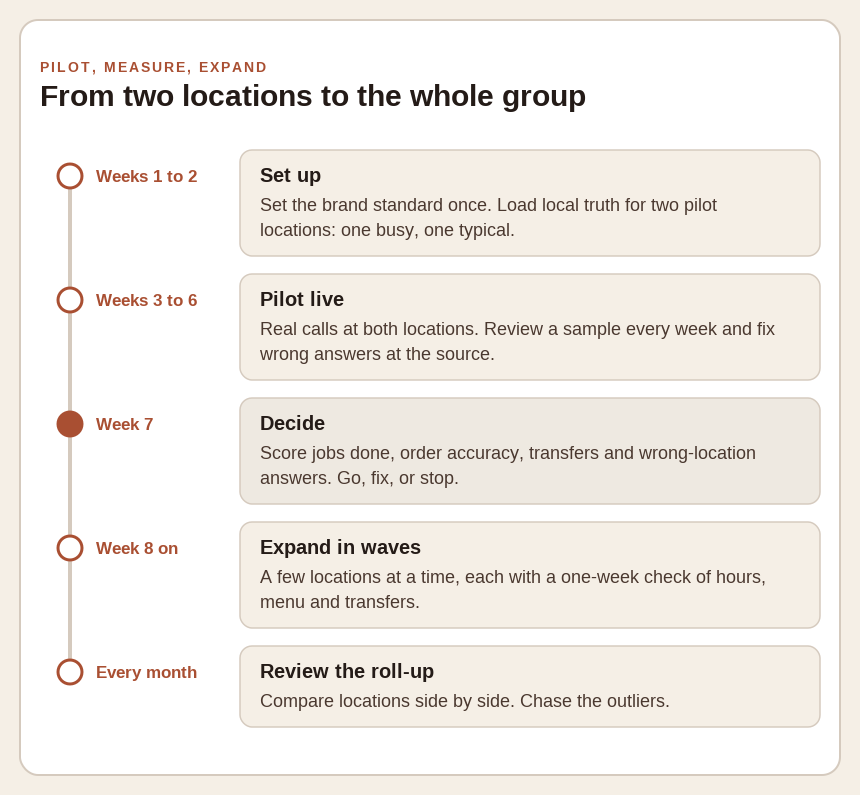
- Pick two pilot locations that differ. One busy, one typical. A pilot at your best-run location alone tells you little.
- Set the brand standard once. Then load each pilot location's local truth.
- Run four weeks on real calls. Review a sample of calls each week. Fix wrong answers at the source, not with a one-off patch.
- Score it. Share of calls that end with the job done, order accuracy, transfers, and any wrong-location answers. Our 30-day pilot scorecard lays out the measures.
- Expand in waves. A few locations at a time, each with a one-week check of local hours, menu and transfers before you move on.
What should a franchisee ask before buying?
- Can I update my hours, menu and 86'd items myself, the same day?
- Do orders land in my POS and kitchen screen, and bookings in my booking system?
- Where do transfers go: my manager on shift, or a central line?
- Who can hear my calls, and which of my numbers does the franchisor see?
- What does it cost for my location, and what changes if I leave the group plan? Our guide to pricing models shows how billing behaves in a busy month.
What should a franchisor ask before buying?
- How is the brand standard set once and applied to every location? What can a franchisee change, and what is locked?
- How are allergy and refund answers kept identical everywhere?
- How does it route a caller to another location, and how does it handle a shared number?
- What does the roll-up report show, and can I compare locations side by side?
- How long does it take to add a new location, or move one to a new owner?
Want to see this across your locations?
TastyVox pricing starts at $99 per location. Multi-location groups get custom pricing. There is no commission and no per-order cut.
Book a fit call and bring the menus and hours for two locations you would pilot first.
Last updated: November 23, 2026.
How this was researched
Franchise ownership figures come from the 2026 Franchising Economic Outlook by the International Franchise Association and FRANdata. The allergy training figure comes from a CDC study published in MMWR in 2017, with data collected in 2014 and 2015 at six US sites. Both are linked where they appear. The standard for multi-location phone agents, the rollout plan and the buyer questions are editorial guidance, not results from customer data. TastyVox builds AI phone agents for venues. No vendor paid for or reviewed this article.
Want to hear what this sounds like in practice?
Listen to a demo call with a real restaurant menu. No commitment, no sales pitch.
Frequently asked questions
Can one AI phone agent answer for every location in a franchise restaurant group?
Yes, if it keeps two layers apart. The brand standard, such as voice, allergy policy and refund policy, is shared. Each location's hours, menu, prices, 86'd items and booking rules are its own. The agent should always know which location the caller means before it quotes anything.
How do you keep allergy answers consistent across locations?
Answer only from one written allergen source per item, owned by the brand, with notes where a location differs. If the answer is not written down, a good agent says it cannot confirm and offers a person. It never guesses.
Who should control the phone agent, the franchisor or the franchisee?
Usually the franchisor sets the standard and each franchisee keeps local facts current. Your franchise agreement may already decide who chooses vendors and who pays. Agree in writing who can change what, and who can see which calls and reports.
How should a multi-unit group pilot AI phone answering and phone ordering?
Pick two locations that differ, one busy and one typical. Run four weeks on real calls, review a sample each week, and score calls that end with the job done, accuracy, transfers and wrong-location answers. Then expand a few locations at a time.
How is phone answering priced for multi-location groups?
Ask whether the price is per location, what group terms apply as you add locations, and the total for a busy month across all of them, in writing.
See how TastyVox sounds with your menu.
Book a 20-minute call and we'll walk through how it works for your specific restaurant.