
Pickleball and Sports Club Phone Calls: Courts, Leagues, Lessons and the Bar
Key Takeaways
- A court is not a table. Member and guest rules, peak limits, cancellation windows and waitlists all apply on every call.
- Four kinds of calls, four finish lines. Each one should leave the call as something your team can use.
- A full court is not a no. A good agent offers the next opening or adds the caller to the waitlist.
- Your pros and membership lead keep the sale. The agent hands them notes.
- Your booking system stays the source of truth. Nothing is booked until it says so.

How should a pickleball or sports club handle its phone calls?
Treat the phone as part of your booking system. A good phone agent at a pickleball or sports club books courts inside the club's rules, offers the waitlist when a court is full, answers program questions from the club's own information and takes food orders. It passes lesson and membership sales to the right person with notes. The booking system stays the one source of truth.
Saturday, 9:15am, and every court is full
Every court is taken. Two groups wait on the bench for 9:30. At the front desk, one person is checking players in and selling a paddle.
The phone rings. Then it rings again.
The first caller wants a court at 6pm tonight. The second is a parent: are there junior clinics for an 11-year-old, and which days? The third is a league captain. Two of his players are out, and he needs to move Tuesday's match. The fourth is a member calling from court 3 between games. She wants two chicken wraps ready when they come off.
The desk can take one of those calls, maybe. The rest ring out. The 6pm caller books somewhere else. The parent forgets to call back. The captain texts the league coordinator, who is off today. The wraps never happen.
Nobody did anything wrong. It is one person, four jobs, peak hour.
Why is a sports club's phone line its own case?
More people are playing. The Sports & Fitness Industry Association counted 24.3 million US pickleball players aged 6 and up in 2025, up from 4.2 million in 2020. The USTA reports a record 27.3 million US tennis players in 2025. More players means more calls.
Volume is not what makes a club different, though. Rules are. A court comes with conditions.
- Members and guests. Members may book further ahead or pay less. Guests may need a member to book for them, or pay a guest fee.
- Peak-hour rules. Prime slots often carry limits: shorter sessions, one booking per member.
- Cancellation windows. Cancel late and you may pay. The caller should hear the rule before they book.
- Waitlists. A full court at 6pm is not a final answer. Courts open up.
- Leagues and ladders. Matches have captains, deadlines and reschedule rules.
- Lessons. Each pro has a calendar, a rate and the levels they teach.
- Food and drink. A café or bar is real money. A phone order should land in the kitchen like any other ticket.
An agent that only answers questions misses most of this. One that books without the rules is worse. It creates the double booking.
What are the four kinds of calls at a club?
Most club calls fall into four groups. Each has a different finish line, and a point where a person should step in.
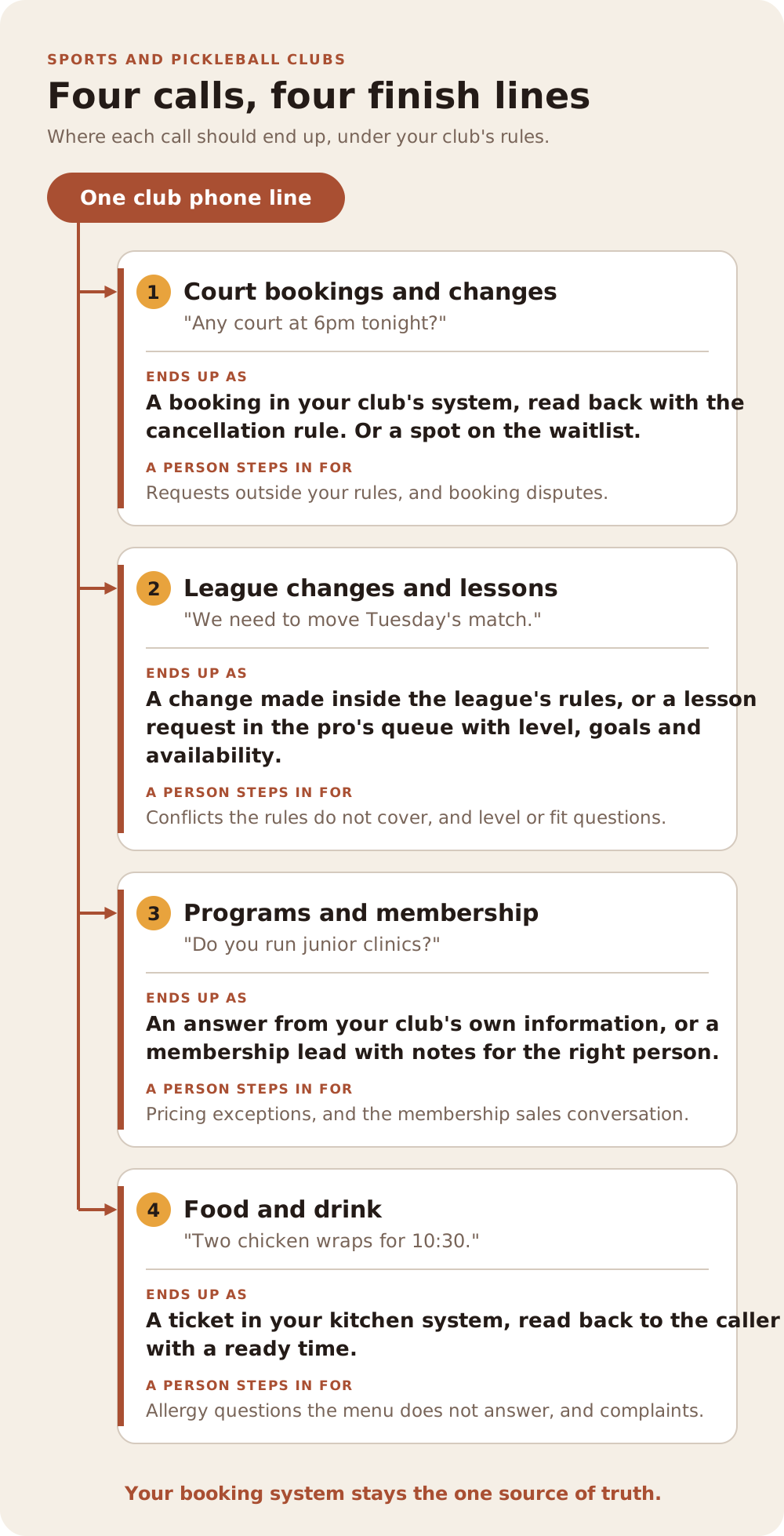
- Court bookings and changes end as a booking in the club's system, or a spot on the waitlist.
- League changes and lessons end as a change made inside the league's rules, or a lesson request with notes for the pro.
- Program and membership questions end as an answer from the club's information, or a lead with notes for whoever sells memberships.
- Food and drink orders end as a ticket in the kitchen.
What should a good phone agent do at a sports club?
Hold any AI receptionist or phone agent to these behaviours.
Book courts inside the club's rules
A good agent asks what it needs: member or guest, how many players, what time. It checks the request against your rules, like booking windows, peak limits and guest fees. Then it makes the booking in your booking system and reads back the court, the time and the cancellation rule.
It never tells a caller a court is theirs until the system has accepted the booking. That matters most when two callers want the same 6pm court.
Offer the next opening, or the waitlist
When 6pm is full, a good agent offers the nearest open times. If the caller wants 6pm or nothing, it adds them to the waitlist the way your club runs it, and says how they will hear if a court opens.
Answer from the club's own information
Junior clinics, open play, ladder rules, guest fees, membership tiers. A good agent answers from what you give it, word for word on prices and rules. If the answer is not there, it says so and takes the question for your team. A wrong answer about ages or prices shows up at your front desk on Saturday.
Move league matches under the league's rules
A captain wants to move a match. A good agent checks who may request a change, the deadline, and whether a court is open at the new time. Inside the rules, it makes the change and the club's usual notice goes to the other team. Outside the rules, it writes up the request for the league coordinator.
Take food and drink orders
A good agent takes the full order, reads it back, gives a ready time and sends it into the kitchen system you already use. Nobody re-keys it. Our guide to POS and kitchen integrations covers that flow.
Hand lessons and memberships to the right person, with notes
A lesson is a question of fit. A membership is a sales conversation. A good agent books a lesson only where a pro has opened slots for phone booking. Otherwise it collects level, goals, availability and a callback time for the pro. Membership callers get the same: which tier, how often they play, when to talk. Once your team replies, the agent sends the caller the next step.
Keep the booking system as the one source of truth
Every booking, change, waitlist spot and cancellation lives in the club's system. The agent keeps no calendar of its own. Outside the rules, it texts your booking link or passes the request to staff, so the caller never hits a dead end.
When should a person take the call?
Some calls need a person
- Complaints about a booking, a coach or another player.
- Injuries and safety. These go to a manager at once.
- Refunds and exceptions to the cancellation or guest rules.
- League disputes about results or eligibility.
A good agent checks the person can take the call before connecting. If nobody picks up, it takes a full message. Our human handoff guide covers how to test this.
What should you set up before launch?
Most of the work is writing down rules your staff already know.
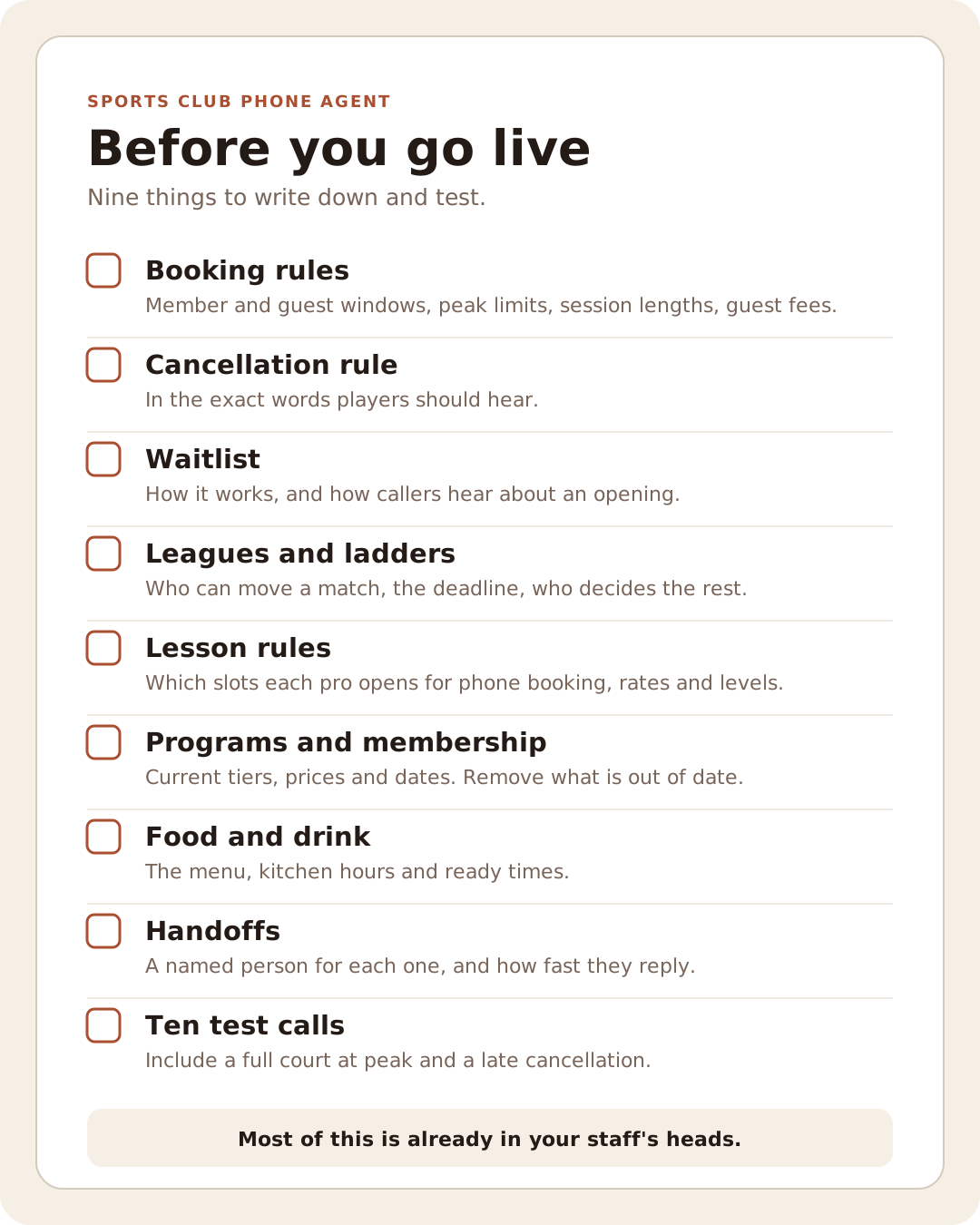
- Booking rules on one page. Windows for members and guests, peak limits, session lengths, guest fees.
- The cancellation rule, in the words players should hear.
- How the waitlist works and how callers hear about an opening.
- League and ladder rules. Who can move a match, the deadline, who decides the rest.
- Each pro's lesson rules. Which slots can be booked by phone, rates and levels.
- Programs and membership tiers, with current prices and dates.
- The food and drink menu and kitchen hours.
- A named person for each handoff, and how fast they reply.
- Ten test calls, including a full court at peak and a late cancellation.
What should you measure in month one?
Read the numbers next to real calls. Twenty calls a week, read by you, tell you more than a dashboard.
| Measure | What it tells you |
|---|---|
| Calls answered, by hour | Whether Saturday morning and weekday evenings are covered |
| Court bookings made by phone | How much booking work left the front desk |
| Phone bookings staff had to fix | Whether your rules are written clearly |
| Waitlist spots that became bookings | Whether full courts are turning into play |
| Questions the agent could not answer | Gaps in your club information |
| Lesson and membership leads, and time to first reply | Whether the handoff reaches your team, and how fast they act |
| Food and drink orders by phone | Whether the kitchen line is getting used |
Our pilot scorecard lays out a fuller 30-day test.
Want to hear this on your own club's calls?
Bring your booking rules and menu to a fit call, or see our page for sports facilities. TastyVox pricing starts at $99 per location. Multi-location groups get custom pricing. There is no commission and no per-order cut.
Last updated: November 17, 2026.
How this was researched
This guide uses two published participation studies: SFIA's pickleball participation research and the USTA's 2025 tennis participation figures. The phone agent standard, the checklist and the month-one measures are editorial guidance on good practice, not results from customer data or claims about any specific product.
Want to hear what this sounds like in practice?
Listen to a demo call with a real restaurant menu. No commitment, no sales pitch.
Frequently asked questions
Can an AI receptionist book pickleball courts by phone?
A good one can. It books inside the club's rules, such as member and guest booking windows, peak limits and guest fees. The booking system stays the source of truth, and the agent never tells a caller a court is theirs until that system accepts the booking.
What happens when the court a caller wants is full?
A good agent offers the nearest open times. If the caller only wants that slot, it adds them to the waitlist the way the club runs it and tells them how they will hear about an opening.
Should an AI phone agent sell lessons and memberships?
It should do the prep, not the selling. It can book lessons into slots a pro has opened for phone booking. Otherwise it collects level, goals, availability and a callback time for the pro or membership lead.
Can a phone agent take food and drink orders at a sports club?
Yes, if the club serves food. A good agent takes the full order, reads it back, gives a ready time and sends it into the kitchen system the club already uses.
See how TastyVox sounds with your menu.
Book a 20-minute call and we'll walk through how it works for your specific restaurant.