
After-Hours Calls: What Venues Lose When the Phone Rings After Close
Key Takeaways
- After-hours callers are often planning ahead. They want an answer now, not a callback tomorrow.
- Voicemail turns a two-minute call into phone tag. The calls that never leave a message are the ones you never hear about.
- Finish what your rules allow tonight. Bookings, answers, and quotes drafted for approval.
- Never promise what only staff can approve. Say what happens next, and when.
- The morning summary is the handoff. What needs action comes first.
What happens to calls that ring after a venue closes?
After close, most venue phones go to voicemail. Messages wait until morning, the callback often goes unanswered, and the caller books somewhere else. A good after-hours phone agent answers every call and finishes what the venue's rules allow. It captures the rest cleanly and gives the team a morning summary sorted by what needs action first. It never promises what only staff can approve.
11:40pm, and the venue is closed
The chairs are up. The kitchen is clean. The last bartender left twenty minutes ago.
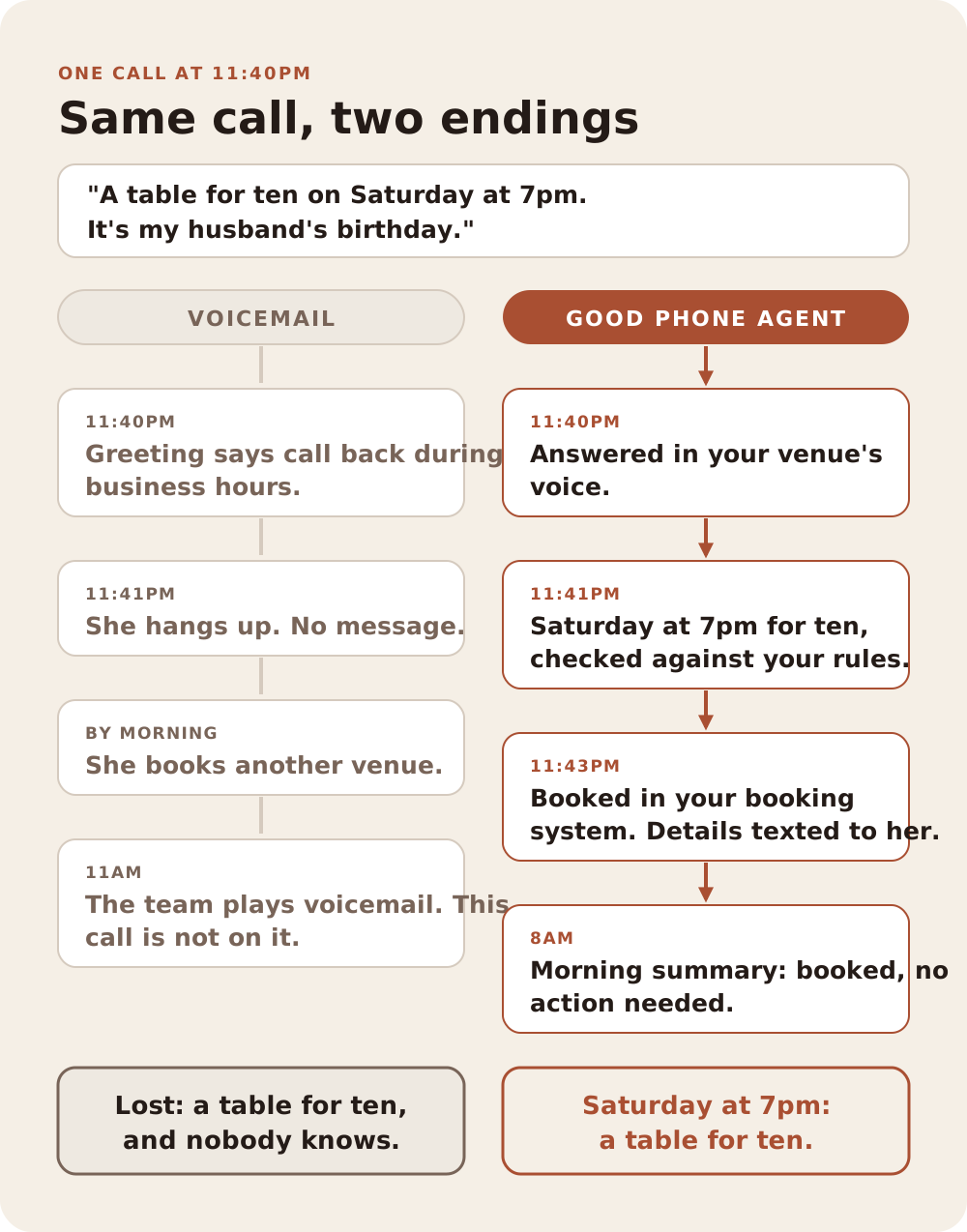
The phone rings. A woman wants a table for ten on Saturday at 7pm. It is her husband's birthday, and she finally has a quiet minute to plan it.
She hears: "Thanks for calling. We are closed. Please call back during business hours."
She hangs up. She does not leave a message. By morning she has booked somewhere else.
At 8am, two more calls come in before anyone arrives. A guest from Friday night thinks he left a navy jacket in a booth. An office manager wants a catering quote for 40 people next Thursday. Both leave messages. The catering caller reads her number fast, and the recording drops two digits.
The manager plays the voicemails at 11am, between deliveries. The jacket message is clear. The catering lead cannot be reached. And nobody knows the birthday caller existed.
That is the real cost of after-hours calls. It is not only the messages you have. It is the calls you never hear about.
Who calls a venue after close, and why?
After-hours callers are not random. Most have a reason to call now.
- Planners. People plan dinners, birthdays and team lunches at night, after work and after the kids are asleep.
- Shift workers. The Bureau of Labor Statistics found 15% of US wage and salary workers usually worked a non-daytime schedule in 2024 and 2025. Your business hours may be their sleep.
- Different time zones. A visitor planning a trip, or an assistant booking for a team in another city, calls on their clock, not yours.
- Early planners. The office manager at 8am wants the catering quote before her 9am meeting.
- Guests who just left. Lost jackets, a card left at the bar, a question about last night's bill.
The mix varies by venue. Some calls are bookings and quotes. Some are lost items and hours checks. All of them want an answer.
Why do voicemail and "call back during business hours" lose them?
Voicemail feels safe. Nothing is missed, because everything is recorded. In practice, four things go wrong.
- Some callers never leave a message. They hang up and call the next venue. You never learn they called.
- Messages go stale. By the time someone listens, the caller has moved on. A request for a table tonight, heard at 11am, may already be too late.
- Callbacks become phone tag. In a 2020 survey, Pew Research Center found eight in ten Americans generally do not answer calls from unknown numbers, and most let them go to voicemail. Your callback can turn into their voicemail.
- Messages are incomplete. A missing digit, no date, no headcount. Now the manager has a lead and no way to act on it.
"Call back during business hours" asks the caller to do the work. And your business hours are your busiest hours, when the phone is hardest to reach. Our look at what missed calls cost covers the daytime side.
What should a good after-hours phone agent do?
Hold any after-hours answering service or AI phone agent to these behaviours.
Answer every call
The first ring at 11:40pm gets the same greeting as the first ring at noon, in your venue's voice. It tells the caller the venue is closed, so nobody expects a manager, and then asks how it can help. No menu tree, no "press 2 for hours." The caller says what they need in their own words.
Finish what your rules allow
If the request fits the rules you set, a good agent finishes it tonight. A table for ten on Saturday at 7pm gets booked in your booking system, and the caller gets the details by text. Questions about hours, parking, the menu or your lost-and-found policy get answered from your own information. If the request falls outside your rules, it texts your booking link or writes up the request for the team.
Draft what needs approval
A catering quote for 40 is not a yes-or-no question. A good agent collects the date, headcount, budget, dietary needs and delivery details. Then it drafts a quote from your menu and prices for the team to approve in the morning. Once approved, the agent sends it and follows up. Our guide to party and group booking calls lists the details worth capturing.
Capture the rest cleanly
The jacket caller gets taken seriously: what it looks like, where he sat, which night, and the best number. The agent reads the number back. Nothing is lost to a fast talker. A question about a charge on last night's bill gets the same care: the details go to the team, and the agent does not guess.
Never promise what only staff can approve
No "we found your jacket." No "the private room is yours." No refunds, comps or price exceptions. A good agent tells the caller exactly what happens next and when, like "the team checks lost and found when they open, and you will hear back by 2pm."
Hand the team a morning summary
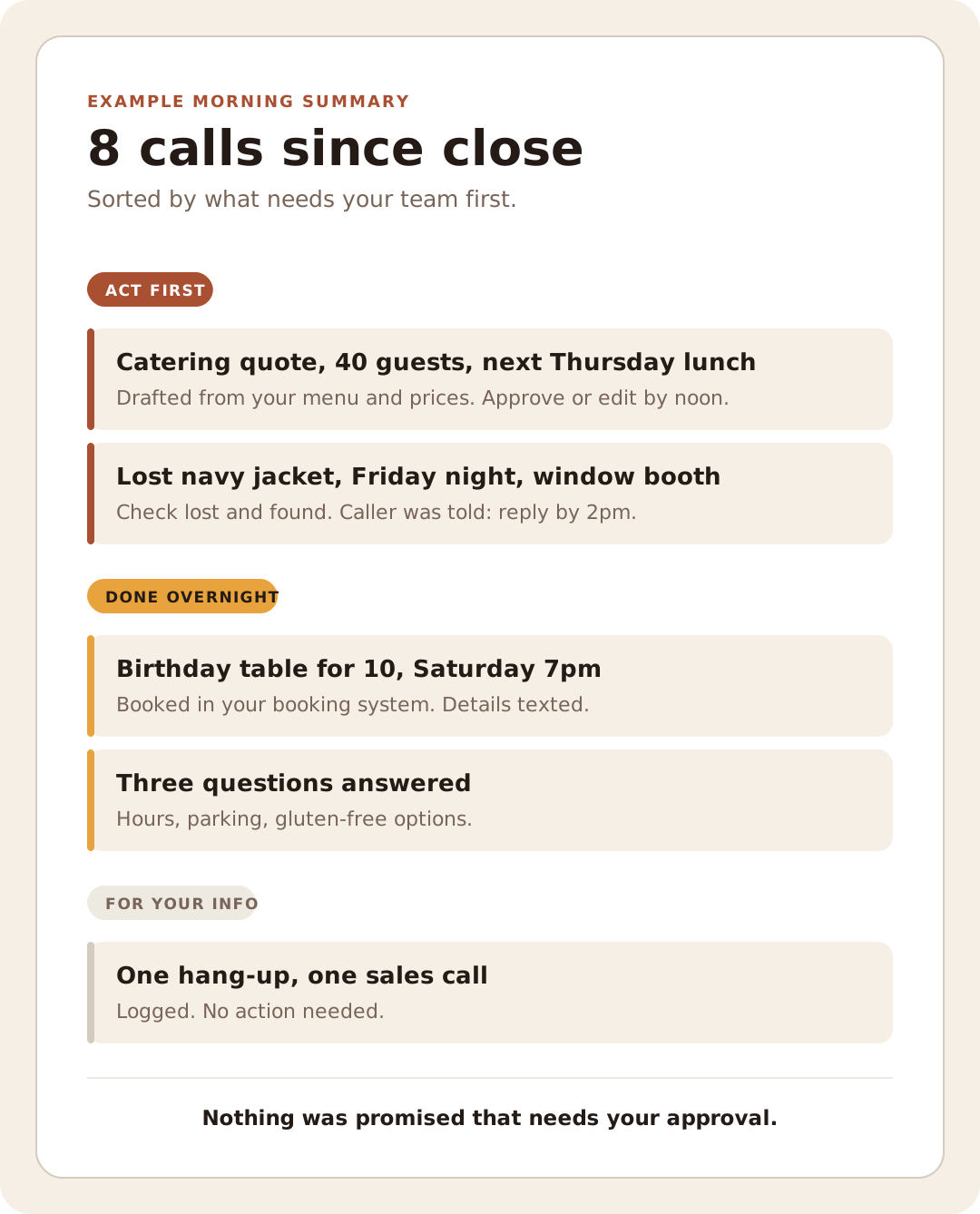
Every overnight call lands in one summary, sorted by what needs action first. Here is an example.
| Priority | Call | Status | What the team does |
|---|---|---|---|
| Act first | Catering, 40 guests, next Thursday lunch | Quote drafted | Approve or edit by noon |
| Act first | Lost navy jacket, Friday, window booth | Details captured | Check lost and found, reply by 2pm |
| Done | Birthday table for 10, Saturday 7pm | Booked in your system | Nothing |
| Done | Three questions: hours, parking, gluten-free options | Answered | Nothing |
| For info | One hang-up, one sales call | Logged | Nothing |
How do you set your after-hours rules?
Write these down before you switch anything on.
- What can be booked after close. Party sizes, how far ahead, which areas, and whether deposits apply.
- Approved answers. Hours, menu, allergen policy, parking, lost and found.
- What gets drafted, not decided. Catering, events, large groups, with your package prices.
- What is never promised. Refunds, comps, found items, exceptions.
- What cannot wait. A safety issue or a problem with an event early tomorrow. Name who gets the call or text.
- Who reads the morning summary, and by what time.
- The callback promise. What callers hear about when the team will reply.
- One test call at 11:40pm. Make it yourself, as a guest.
Most of this is already in your managers' heads. Our human handoff guide covers what should go to a person, and the pilot scorecard covers how to test it.
What should you watch in the first month?
Read the morning summary every day for a month, and listen to a few overnight calls each week. Track five things:
- Overnight calls by type. Bookings, quotes, questions, lost items. This is your after-hours mix.
- Bookings made after close that your team did not have to fix.
- Drafts approved, edited or declined. Lots of edits means your prices or packages need updating.
- Questions the agent could not answer. Each one is a gap in your information.
- Time from summary to action. A summary nobody reads by noon is just a nicer voicemail.
Want to hear an after-hours call on your own rules?
Bring your booking rules and catering menu to a fit call. TastyVox pricing starts at $99 per location. Multi-location groups get custom pricing. There is no commission and no per-order cut.
Last updated: November 21, 2026.
How this was researched
This guide uses two published sources: a Pew Research Center survey on how Americans handle calls from unknown numbers, and Bureau of Labor Statistics data on work schedules. The phone agent standard, the morning summary example and the after-hours checklist are editorial guidance on good practice, not results from customer data or claims about any specific product.
Want to hear what this sounds like in practice?
Listen to a demo call with a real restaurant menu. No commitment, no sales pitch.
Frequently asked questions
Is an AI phone agent better than voicemail after hours?
For most venues, yes, if it acts under your rules. Voicemail records a message and waits. A good agent answers the call, books what your rules allow, drafts what needs approval, and puts everything in a morning summary.
How is an AI phone agent different from an after-hours answering service?
A basic answering service takes a message for the team to return. A good AI phone agent can also finish work under the venue's rules, like making a booking in the venue's system or drafting a catering quote for approval. Either way, ask what leaves the call: a message, or a finished task.
What should an after-hours phone agent never promise?
Anything only staff can approve: refunds, comps, price exceptions, found items, or a private room that has not been approved. It should tell the caller what happens next and when they will hear back.
What should a morning summary include?
Every overnight call, sorted by what needs action first. Each line should say what the caller wanted, what the agent already did, and what the team needs to do, with any deadline.
See how TastyVox sounds with your menu.
Book a 20-minute call and we'll walk through how it works for your specific restaurant.