
Restaurant Answering Service, Phone Menu or AI Phone Agent: Which Fits Your Venue?
Key Takeaways
- Judge each option by how the call ends. Routed, a message to return, or the job done.
- Callers route around phone menus. In a 2019 Clutch survey, 70% said they had pressed zero to reach a person.
- An answering service is friendly but cannot see your venue. No menu, no booking sheet, no kitchen. Calls often end as a message.
- An AI phone agent can finish the job inside your rules. Only if it has your current menu and rules, and a person is easy to reach.
Restaurant answering service, phone menu or AI phone agent: which should a venue choose?
Choose by how you want the call to end. A phone menu suits a line that only gives out hours and directions. A human answering service suits low volume and sensitive calls. An AI phone agent suits a busy line where most calls should end with the job done: an order in the kitchen, a booking in your system or a quote drafted for your team, if it is set up well.
It is Saturday, 7:40pm. The host is seating a table of eight. The bar is two deep. The phone behind the host stand rings out for the fourth time in ten minutes.
On Sunday the owner scrolls a long column of missed calls. Some were hang-ups. Some were a takeout order, a birthday for 12, a question about the patio. There is no way to tell which.
By Monday there are three options on the table: a phone menu ("press 1 for hours"), a restaurant answering service staffed by people, or an AI phone agent. Here is how they compare.
What does each option do with a call?
A phone menu (IVR)
A phone menu, or IVR (interactive voice response), plays a recording and routes the caller by keypad or a few spoken words. It never gets tired. But it can only play what you recorded and send the call somewhere else.
Callers know this, and they route around it. In a 2019 Clutch survey of 501 US adults who call businesses, 88% said they prefer a live agent to a phone menu, and 70% had pressed zero to reach a person. Their top complaint was irrelevant options.
A 2019 survey commissioned by Vonage, a company that sells business phone systems, found US consumers said they had abandoned 27% of their calls to businesses in the past year because they reached an automated menu.
At a venue, "press 0" during a rush rings the same phone nobody could reach.
A restaurant answering service
A restaurant answering service is a team of people, off site, who pick up in your venue's name. They follow your script, answer common questions from a sheet, and take messages. A good one is warm and handles odd calls well.
The limit is what they can see. They cannot check whether the 8pm table is free or whether the kitchen is out of short rib. So a booking request becomes a message. So does a takeout order. Someone on your team still has to call back and finish the job.
That is the question to ask any answering service for restaurants: when the call ends, what is done, and what is still waiting for your team?
An AI phone agent
An AI phone agent is software that holds the conversation itself. Under rules you have approved, a good one takes the order and sends it to your POS and kitchen screen, makes the booking in your booking system, or drafts the event quote for your team to approve. Then it follows up. Your ordering and booking systems stay the one source of truth.
It still needs people. Complaints, refunds, safety and exceptions go to a person. Callers care about this. In a Gartner survey of 5,728 customers, run in December 2023, 64% said they would prefer companies did not use AI in customer service. Their top worry was that it would be harder to reach a person.
So "set up well" carries real weight. The agent is only as good as the menu, rules and handoff you give it.
How do the three compare on what matters to an operator?
| What matters | Phone menu | Answering service | AI phone agent, set up well |
|---|---|---|---|
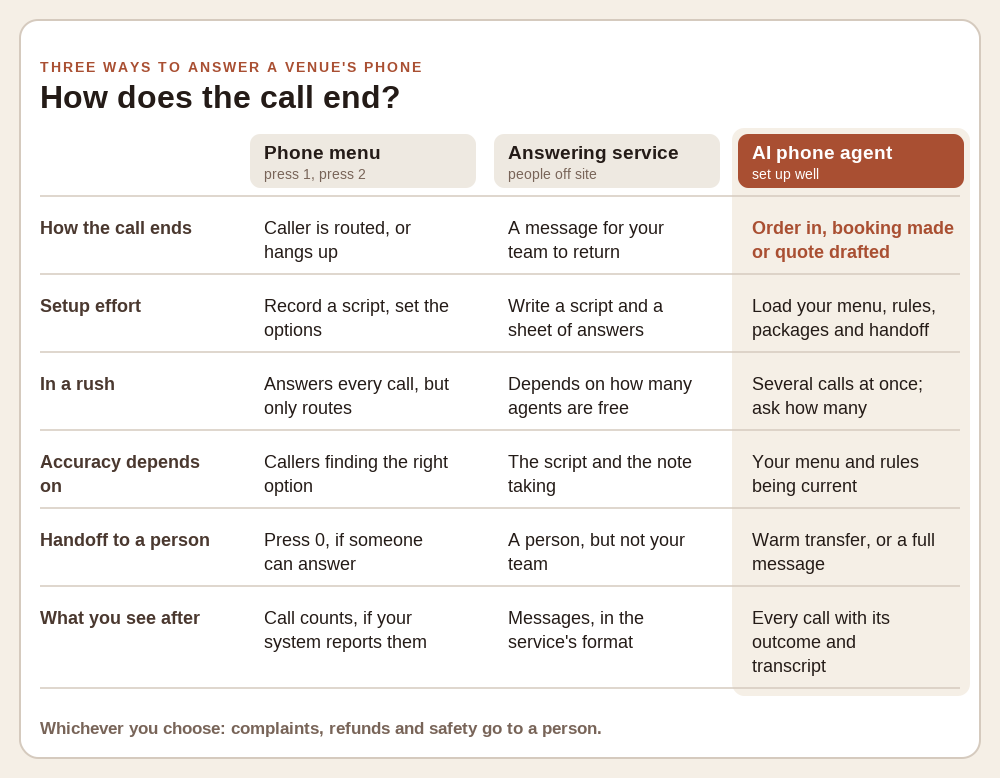
| How the call ends | Caller is routed, or hangs up | A message for your team to return | Order in, booking made or quote drafted |
| How you pay | Set by your phone system provider | Ask: per minute, per call or a monthly plan | Ask: flat fee, per minute or per order |
| Setup effort | Record a script, set the options | Write a script and a sheet of answers | Load your menu, rules, packages and handoff |
| In a rush | Answers every call, but only routes | Depends on how many agents are free | Several calls at once; ask how many |
| Accuracy depends on | Callers finding the right option | The script and the note taking | Your menu and rules being current |
| Handoff to a person | Press 0, if someone can answer | It is a person, but not your team | Warm transfer, or a full message |
| What you see afterwards | Call counts, if your system reports them | Messages, in the service's format | Every call with its outcome and transcript |
Does the call end with the job done?
This is the row that matters most. A routed call or a message still needs your team. A finished call does not.
Picture the birthday caller on Saturday night. A phone menu sends her to an events line that rings out. An answering service takes her details. With a good AI phone agent, her details and a draft quote built from your packages are waiting for your events lead on Monday morning. The lead approves it, and the agent sends it and follows up.
What does each option really cost?
Compare the cost of a call that ends with the job done, not monthly prices alone. A phone menu that callers hang up on is not cheap. Our guide to pricing models for venue phone AI shows how each one behaves in a busy month.
What happens in a rush?
Ask every provider: five people call at 7pm on a Saturday, so what does each one hear? A phone menu answers all five and sends them to the phone nobody can reach. An answering service depends on how many of its people are free. An AI phone agent should take several calls at once; ask how many your plan includes.
How accurate is it?
Phone menus fail when the caller's reason is not listed. Answering services fail on the note: a wrong digit in a callback number, a missed allergy. AI agents fail when the menu or rules they work from are out of date, like an 86'd dish still on sale. Test any of them with your hardest calls. Our guide to menus and modifiers on phone orders lists what to try.
What do you see the next morning?
A good AI phone agent should show every call with its outcome: order placed, booking made, quote drafted, transferred, or message taken. Then you know what the phone did last night, not just how often it rang. Our guide on what missed calls cost shows how to put a number on the rest.
When is a phone menu or an answering service the right call?
An AI phone agent is not always the answer. Be honest about your line.
- Very low volume. A few calls a day, mostly about hours and parking? A short recorded greeting or a two-option menu is enough.
- Simple information lines. A line that only gives out directions or gift card balances does not need a conversation.
- Highly sensitive calls. An injury, a serious complaint, a guest in distress, anything legal. These need a person. A trained answering service can be a good safety net when you are closed. A good AI phone agent sends these calls to a person too.
- Nobody to own the follow-up. If no one will review messages and drafts, fix that first.
You can also mix them: an AI phone agent for orders, bookings and questions, and a named person for everything sensitive.
Which option fits your venue?
Here are three common profiles.
If your line is quiet and simple
You run a small wine bar with walk-ins only. The phone rings a few times a day, almost always "are you open?" A clear recorded greeting or a two-option phone menu is enough. Keep your hours current online and spend the money elsewhere.
If your calls are few but delicate
You run a private dining room or an event space. Calls are rare, long and personal: a rehearsal dinner, a memorial lunch. Each one deserves a person. A human answering service, or forwarding to your events lead's mobile, is the right fit. Ask the service to capture the seven details every party call needs.
If your phone rings through the rush
You run a busy venue with a kitchen. On Friday and Saturday nights the phone rings through with takeout orders, bookings and party questions. This is where an AI phone agent earns its place. Give it your menu, booking rules, packages and a named person for handoffs. Then test it on real calls with our 30-day pilot scorecard.
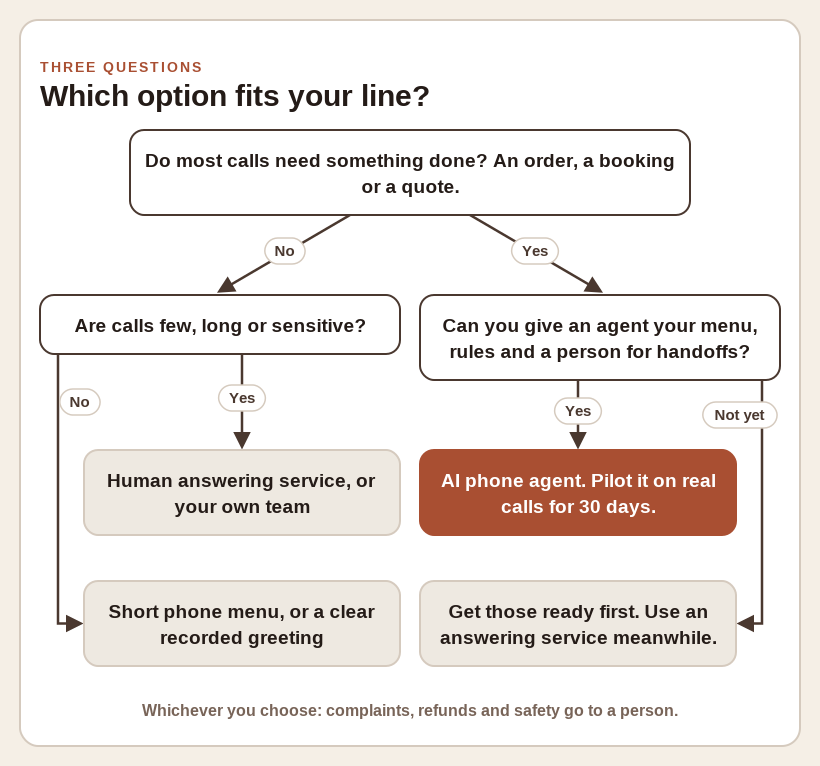
Not sure which profile is yours? Run your line through three questions.
What should you ask before you sign any of them?
- On a test call, what is left when the call ends? A kitchen ticket, a booking, a draft quote or a message.
- Where does it land? In your POS, kitchen screen and booking system, or in an inbox? See our guide to integrations and the source of truth.
- What does each caller hear in a rush? Five calls at 7pm on a Saturday.
- How does a caller reach a person? And what if nobody picks up? Our guide to transfers to a person shows how to test it.
- What does a busy month cost? Get it in writing.
- What will you see the next morning? Call by call, with outcomes.
Want to test this on your own calls?
TastyVox pricing starts at $99 per location. Multi-location groups get custom pricing. There is no commission and no per-order cut.
Book a fit call and bring a week of call logs.
Last updated: November 24, 2026.
How this was researched
Survey figures come from a 2019 Clutch survey of 501 US adults, a 2019 survey of 2,010 US adults commissioned by Vonage, which sells business phone systems, and a Gartner survey of 5,728 customers fielded in December 2023. Each is linked where it appears. The comparison of options and the standard for a good AI phone agent are editorial guidance, not results from customer data. TastyVox builds AI phone agents for venues. No vendor paid for or reviewed this article.
Want to hear what this sounds like in practice?
Listen to a demo call with a real restaurant menu. No commitment, no sales pitch.
Frequently asked questions
What does a restaurant answering service do?
A restaurant answering service is a team of people, off site, who answer your calls in your venue's name when you are busy or closed. They answer common questions from a script, take messages and pass on booking and order requests. Because they cannot see your menu, booking sheet or kitchen, most of those calls end as a message your team returns. Ask any service how it handles a takeout order, a booking and an allergy question.
What is the difference between an answering service and an AI receptionist?
An answering service is a team of people who pick up in your name, follow a script and take messages. An AI receptionist, or AI phone agent, is software that holds the conversation. A good one takes the order, makes the booking or drafts a quote under rules you approve, and hands complaints and exceptions to a person.
Is an IVR phone menu a good fit for restaurants and other venues?
For a quiet line with simple questions, a short one can be. On a busy line, callers route around it: in a 2019 Clutch survey of US adults, 70% said they had pressed zero to reach a person. A phone menu also cannot take an order or make a booking.
Can a virtual receptionist for restaurants take orders and bookings?
It depends on what is behind the voice. A human virtual receptionist works from a script and cannot see your menu or booking sheet, so orders and bookings usually become messages. A well set up AI phone agent can place the order in your POS and make the booking in your booking system, inside your rules. Ask to see a test order reach your kitchen.
Is an AI phone agent cheaper than an answering service?
It depends on your call volume and the billing model. Compare the cost of a call that ends with the job done, not the monthly price alone. Ask each provider to price your busiest month in writing.
Will callers be put off by talking to an AI phone agent?
Some will. In a 2024 Gartner survey, customers' top worry about AI in customer service was that it would be harder to reach a person. A good agent tells callers how to reach one, transfers warmly when asked, and takes a full message if nobody can pick up.
See how TastyVox sounds with your menu.
Book a 20-minute call and we'll walk through how it works for your specific restaurant.