
Should Your Venue's Phone Agent Sound Like You? Voice Cloning, Consent and Disclosure
Key Takeaways
- The question is not "can we" but "should we". Voice AI can now speak in a custom or cloned voice. Consent and honesty are the real work.
- There are three kinds of voice. A stock voice is ready-made. A custom brand voice is built for you and copies no one. A cloned voice copies a real person.
- Consent comes first, in writing. The person signs before any recording, knows the uses, and can withdraw.
- Tell every caller it is an AI assistant. Some states require it in some cases. Guest trust requires it in all of them.
- Plan the exit on day one. People leave. Their voice should not stay behind on your phone.
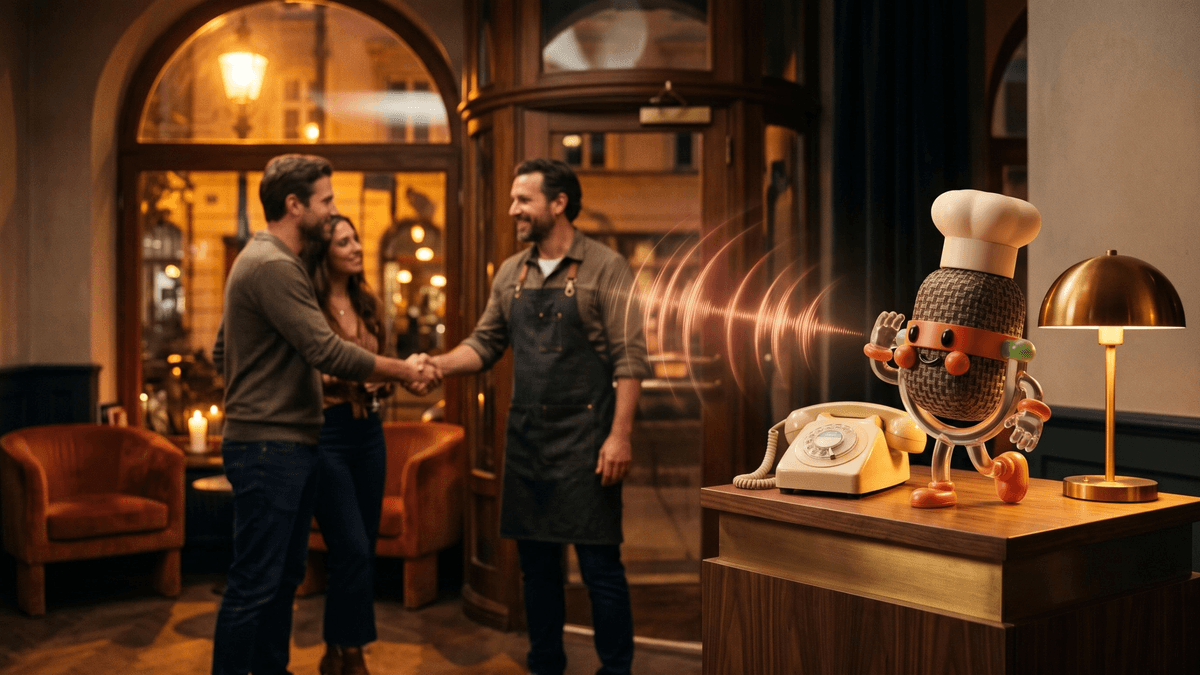
Should your venue's phone agent use a cloned voice?
It can, but only with three things in place: written consent from the person whose voice it is, a clear line at the start of every call that the caller is speaking with an AI assistant, and a plan for the day that person leaves. Without all three, a stock voice or a custom brand voice is the better choice. Most venues do not need a clone to sound warm.
The phone is part of the brand
Think about the voice on your phone. Maybe it is the owner, who picks up on a slow Tuesday and knows half the callers by name. Maybe it is the host whose "thanks for calling" regulars could recite. Callers hear that voice before they see the room. For many guests, it is the first taste of the place.
Now voice AI can answer that phone in a voice you choose. Not only a stock voice from a list, but a custom voice built for your venue, or a clone of a real person's voice made from recordings. If you have looked at a custom AI voice for restaurants or venues, you may have heard a demo that sounded very close to a real person.
So the question has changed. It is no longer "can we make the phone agent sound like the owner?" It is "should we, and how do we do it right?" This guide covers the options in plain words, when a familiar voice helps, when it backfires, the rules to know as checked in November 2026, and the standard a good AI phone agent should meet. If you are still deciding whether AI phone answering fits your venue at all, start with how AI phone answering works for activity venues.
What is the difference between a stock, custom and cloned voice?
The three options differ in whose voice it is and what can go wrong.
- Stock voice. A ready-made synthetic voice that a voice provider offers to everyone. It belongs to no one at your venue. You pick the one that fits your tone.
- Custom brand voice. A synthetic voice designed for your venue, with the pace, warmth and accent you choose. It is not meant to sound like any real person.
- Cloned voice. A synthetic copy of a specific, real person's voice, made from recordings of that person. Callers who know the person may recognise it.
| Stock voice | Custom brand voice | Cloned voice of a real person | |
|---|---|---|---|
| Whose voice is it? | No one at your venue | No one; it is designed for your venue | A specific person, such as the owner or a host |
| Whose consent do you need? | None beyond the provider's terms | A voice actor's, if one was recorded to build it | That person's, in writing, before any recording |
| Will regulars recognise it? | No | Over time, as your sound | Yes, from the first call |
| What if someone leaves? | Nothing changes | Nothing changes | The voice comes off the phone, under the consent terms |
| Main risk | Sounds generic | Sounds off-brand | Guests feel tricked; claims over the person's voice |
There is a simpler fourth option many venues forget. The owner records the welcome line in their own voice, and the AI assistant takes the rest of the call in a stock or custom voice. "Thanks for calling. This is [your name], the owner. Our AI assistant will take it from here." Regulars hear the person they know, then a voice that is clearly not that person.
When does a familiar voice help?
A familiar voice helps when guests already know it, the person will stay, and the agent says plainly that it is an AI assistant.
- Brand warmth. At a family-run venue, the owner's voice can be part of the story. Callers hear the same welcome they get at the door.
- Continuity. A group with several locations wants every call to sound like one brand. A custom brand voice does this well, and it is not tied to anyone's job.
- A recognisable greeting. Regulars know the line. Often a recorded greeting gives you this without cloning anything.
Two of these three work just as well with a custom brand voice or a recorded greeting. A clone is the right tool only when the specific person matters to guests.
When does a cloned voice backfire?
- It sounds almost right. A familiar voice that pauses in the wrong place, or says a regular's name wrong, feels worse than a stranger's voice. People notice small errors in a voice they know.
- The person leaves. The host who lent their voice takes a job across town. Their voice is still answering your phone. Unless your agreement covered this, you have a problem with that person, and possibly a legal one.
- Guests feel tricked. A regular thinks they spoke with the owner, then finds out it was software. Callers are already on guard. The FTC warns that scammers use voice cloning to make fake family emergency calls more believable. No venue wants to sound like that.
- Staff feel pushed. When a manager asks an hourly host for their voice, saying no may not feel like a real choice. Consent that is not free is not consent.
Is AI voice cloning legal for a business phone?
No single US law bans a venue from using a cloned voice with the person's permission. But federal rules and a growing set of state laws cover three things: consent to use someone's voice, impersonation, and telling people when they are talking to AI. The table below summarises what we found when we checked in November 2026. It is not legal advice. Rules change and differ by state, so confirm with counsel for each state where you operate.
| Rule | What it covers | What it means for a venue phone agent |
|---|---|---|
| FCC declaratory ruling, February 2024 | AI-generated voices, including voice cloning, count as an "artificial" voice under the Telephone Consumer Protection Act. Such calls generally need the called person's prior express consent and must identify the caller (FCC ruling page; Wilson Sonsini summary). | It covers calls you place. If your agent makes callbacks or reminder calls, those are covered. |
| FCC proposed rule, 2024 | Would define an AI-generated call as an outbound call and require a disclosure at the start of each one. The FCC said the TCPA's requirements "do not extend to technologies used to answer inbound calls" (Federal Register, September 2024). | Still a proposal. Answering a guest's call is treated differently from calling them. State laws below can still apply. |
| FTC Act and FTC Impersonation Rule | The FTC has said its ban on deceptive conduct can apply to making, selling or using a tool designed to deceive. Its Impersonation Rule bans impersonating government, businesses and their officers or agents. A proposed extension to impersonating individuals was still being evaluated in October 2026. | Never let the agent pretend to be a person. Never use a voice that imitates someone who has not agreed. |
| Tennessee ELVIS Act, in effect July 1, 2024 | Gives every individual a property right in their voice, including a simulation of it, and covers knowing use for advertising goods or services without consent (Public Chapter 588). | In Tennessee, a cloned voice needs the person's authorization. Get it in writing. |
| California Civil Code section 3344 | Bars knowingly using another person's voice for advertising or selling without prior consent (section 3344). A 2025 amendment, SB 683, extended it to digital replicas and added faster court orders. | A phone agent that takes orders may count as selling. Get written consent. |
| California Labor Code section 927 | For performances recorded on or after January 1, 2025, a contract term letting a digital replica of a worker's voice do work they would have done in person can be unenforceable unless it describes the uses and the worker had a lawyer or union (section 927). | Asking a California employee for their voice needs a specific written agreement, and time for them to get advice. |
| California bot disclosure law, 2019 | Bars using a bot "online" to mislead someone about its artificial identity to drive a sale, with a safe harbor for clear disclosure (SB 1001). A 2025 bill to broaden it, AB 410, stalled in a Senate committee. | It is written for online bots. Whether it reaches a phone call is unclear. Disclose anyway. |
| Utah AI Policy Act, amended 2025 | A business must disclose that a consumer is dealing with generative AI when the consumer clearly asks. Clear disclosure at the start and throughout earns a safe harbor (Davis Polk summary). | If a caller asks "am I talking to a real person?", the agent tells the truth. |
| Maine, 10 M.R.S. section 1500-DD, 2025 | Covers software that simulates conversation through "textual or aural communications". If a reasonable consumer could think they are talking to a human, the business must say clearly that they are not (statute). | Phone agents are in scope. Say it is AI at the start of the call. |
Congress is also weighing a federal right over digital replicas of voice and likeness, the NO FAKES Act. It cleared the Senate Judiciary Committee in June 2026, then stalled on the Senate floor on September 30, 2026. It was not law when we checked.
What standard should a good AI phone agent meet?
Whatever voice you choose, hold your phone agent and any vendor to these six standards. In most states they go beyond the legal minimum. They are what keeps guests' trust.
A familiar voice is a finish, not the job. A good agent still takes the order or makes the booking under the rules you set, with your ordering or booking system as the one source of truth.
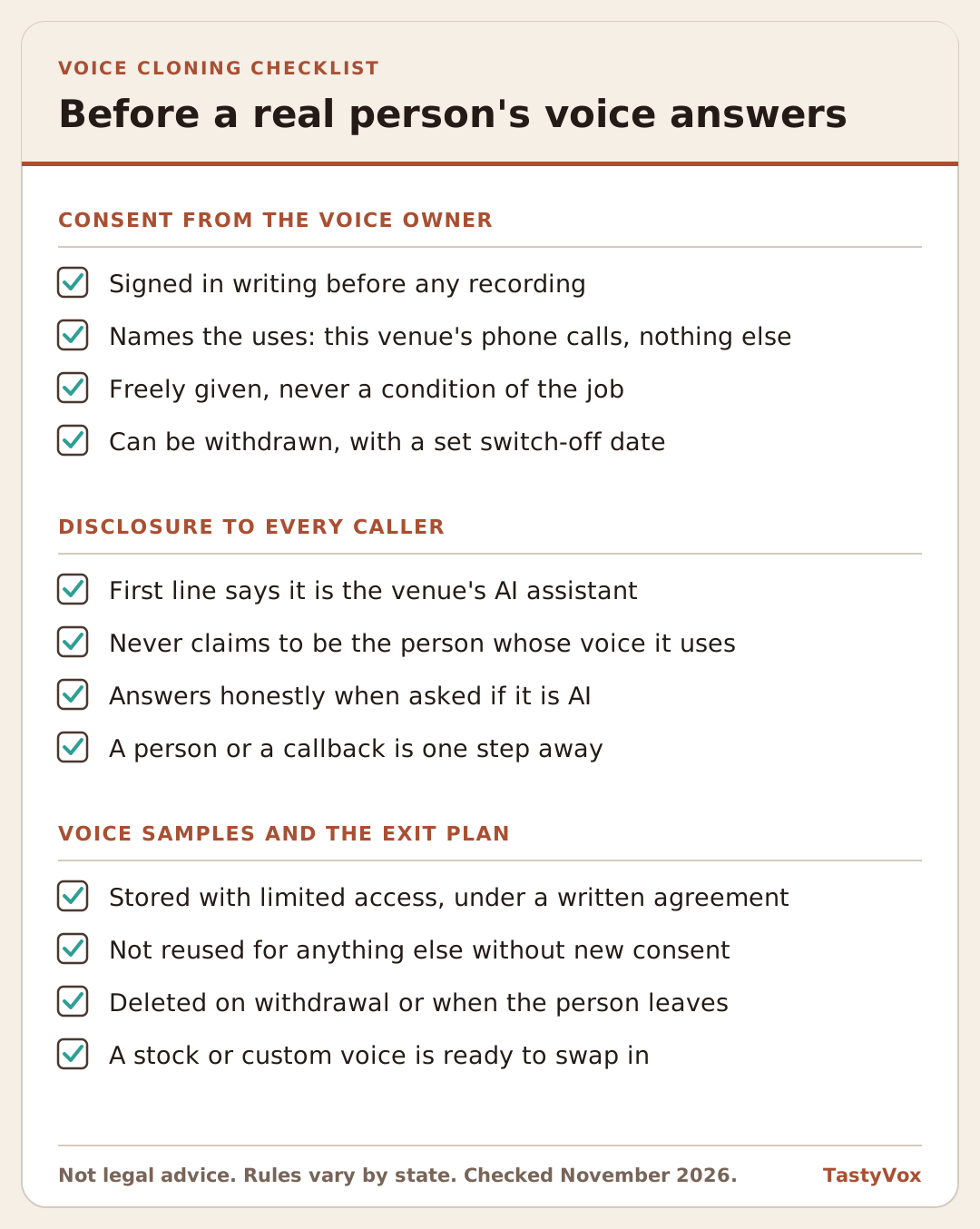
1. Written consent from the person whose voice is used
Consent is signed before any recording. It names the uses, such as phone calls for this venue, the term, any pay, and who can access the voice. It is freely given and never a condition of keeping a job. The person can withdraw at any time, and the agreement says how fast the voice comes off the phone.
2. Clear disclosure at the start of every call
The first line says what the caller is talking to. "Thanks for calling. You're speaking with our AI assistant." Short and warm, with no apology. If a caller asks "is this [name]?" or "am I talking to a real person?", the agent answers honestly. In a cloned voice, it never says "this is [name]".
3. No imitation of a real person without permission
No celebrity soundalike. No former host. No voice built to sound "a bit like" a well-known local chef. If a voice is meant to be recognised as someone, that someone has agreed in writing.
4. An easy path to a person
Disclosure only works if the caller has a choice. A guest who does not want to talk to an AI can ask for a person and get a transfer or a callback, under the rules you set. We cover the patterns in when voice AI should transfer a call to a human.
5. Secure handling of voice samples
Recordings used to build a clone are sensitive. Ask the provider, in writing, where samples are stored, who can access them, whether they are used for anything else, such as training other voices, and how fast they are deleted on request. Illinois' Biometric Information Privacy Act lists a "voiceprint" as a biometric identifier. Whether cloning samples count is a question for counsel. Treat them as if they do.
6. A plan for when the voice owner leaves
Decide this on day one and write it into the consent. When the person leaves, the voice comes off the phone by a set date, the samples are deleted, and a stock or custom brand voice is ready to swap in. Test the swap before you need it.
Decision checklist: which voice should your venue use?
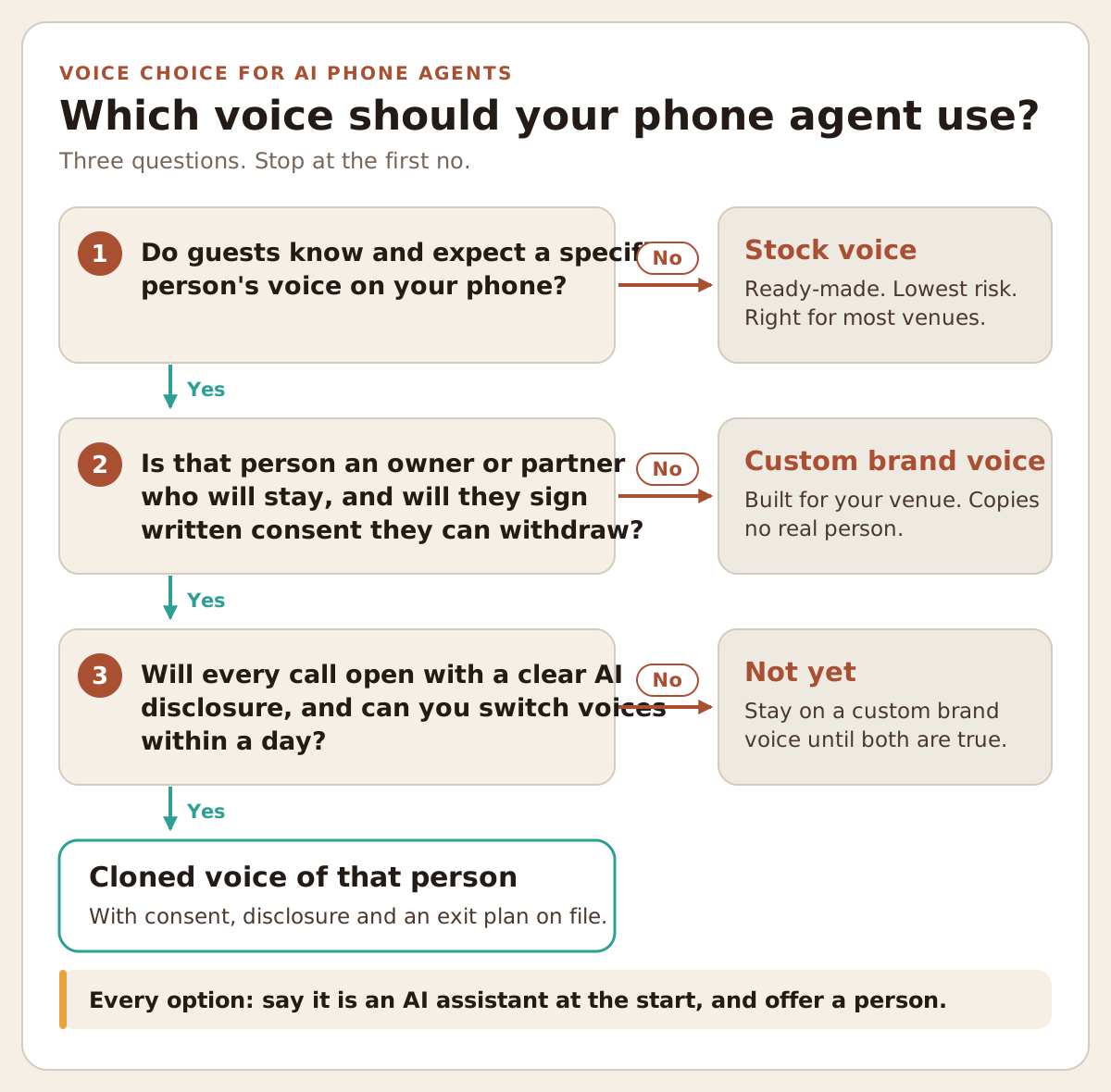
Answer these before you pick a voice. One "no" in the first five points to a stock or custom brand voice.
- Do guests know and expect a specific person's voice on your phone?
- Is that person an owner or partner who expects to stay?
- Will they sign written consent that names the uses and lets them withdraw?
- Will every call open with a clear line that the caller is speaking with an AI assistant?
- Can you switch to another voice within a day?
- Have you checked the rules in each state where you operate, with counsel?
Consent checklist: what the agreement should cover
- Who. The person's name, and a line that they agreed freely.
- What. The exact uses: this venue's phone calls, at named locations. Name what is excluded, such as ads, social posts or other businesses.
- How long. A start date and an end or review date.
- Pay. Any payment for the use, or a clear statement that there is none.
- Withdrawal. How to withdraw, and how fast the voice comes off the phone.
- Leaving. What happens to the voice and the samples when the person leaves.
- Samples. Where recordings are stored, who can access them, and when they are deleted.
- Advice. Time to get independent advice. In California, see Labor Code section 927 above.
A familiar voice can make a phone agent feel like part of the place. It only works if guests know what they are talking to, and the person behind the voice is glad to lend it. If you are also weighing cost, see how venue phone AI pricing models compare. TastyVox pricing starts at $99 per location. Multi-location groups get custom pricing. There is no commission and no per-order cut.
Rules checked November 2026. This article is general information, not legal advice. Confirm with counsel for your state.
How this was researched
This guide summarises selected US federal and state rules on AI-generated voices, voice rights and AI disclosure, as checked in November 2026 against the statutes, agency documents and law-firm summaries linked in the article. It is general information, not legal advice, and it is not a complete survey of every state. The voice options, the six-part standard and the checklists are editorial guidance, not results from customer data.
Want to hear what this sounds like in practice?
Listen to a demo call with a real restaurant menu. No commitment, no sales pitch.
Frequently asked questions
Is AI voice cloning legal for a business phone line?
In the US, no single law bans it when the person whose voice is cloned gives permission. Using someone's voice without consent can break state laws such as Tennessee's ELVIS Act and California Civil Code section 3344, and some states require telling callers they are talking to AI. Get written consent, disclose on every call, and confirm with counsel for your state. Rules checked November 2026.
Do I have to tell callers they are talking to an AI phone agent?
In some states and situations, yes. Maine requires a clear notice when a reasonable consumer could think they are talking to a human, and Utah requires a truthful answer when a consumer clearly asks. Other laws are narrower. Saying so at the start of every call meets the strictest of these rules and keeps guests' trust.
Does the FCC's 2024 AI voice ruling apply to calls guests make to my venue?
The February 2024 ruling covers calls placed using AI-generated voices, which generally need the called person's consent. In its 2024 proposed rule, the FCC said the TCPA's requirements do not extend to technologies used to answer inbound calls. If your agent places callbacks or reminder calls, those outbound calls are covered. State disclosure laws can still apply to inbound calls.
Can I clone an employee's voice for our phone agent?
Only with their free, written consent, and think hard first. Employees may not feel free to say no, and they leave. In California, contract terms for a digital replica of a worker's voice can be unenforceable unless they describe the uses and the worker had a lawyer or union. A custom brand voice avoids most of this.
What happens to a cloned voice when the person leaves the business?
Whatever the consent agreement says, so write it down on day one. A good standard: the voice comes off the phone by a set date, the samples are deleted, and a stock or custom brand voice is ready to swap in.
Is a custom brand voice safer than a cloned voice?
Usually. A custom brand voice is designed for your venue and copies no one, so there is no person whose consent can lapse or who can leave. If a voice actor was recorded to build it, get that actor's written consent for the use.
See how TastyVox sounds with your menu.
Book a 20-minute call and we'll walk through how it works for your specific restaurant.