
Brewery Phone Orders: How to Stop Losing Takeout When the Taproom Is Full
Key Takeaways
- The phone sits with the wrong team. At a brewery kitchen, bar staff own the phone, so every takeout call costs a guest at the bar some time.
- A good agent takes the order, not a message. Live menu, careful modifiers, an honest ready time, payment, and one ticket in your ordering system.
- Your licence decides beer to go. Rules vary by state and locality. Write your rule down and hold the phone agent to it.
- Judge week one by the tickets. Paid orders, ready-time accuracy, out-of-stock misses and kitchen fixes tell you more than a quiet phone.
Why do brewery phone orders go wrong on a busy night?
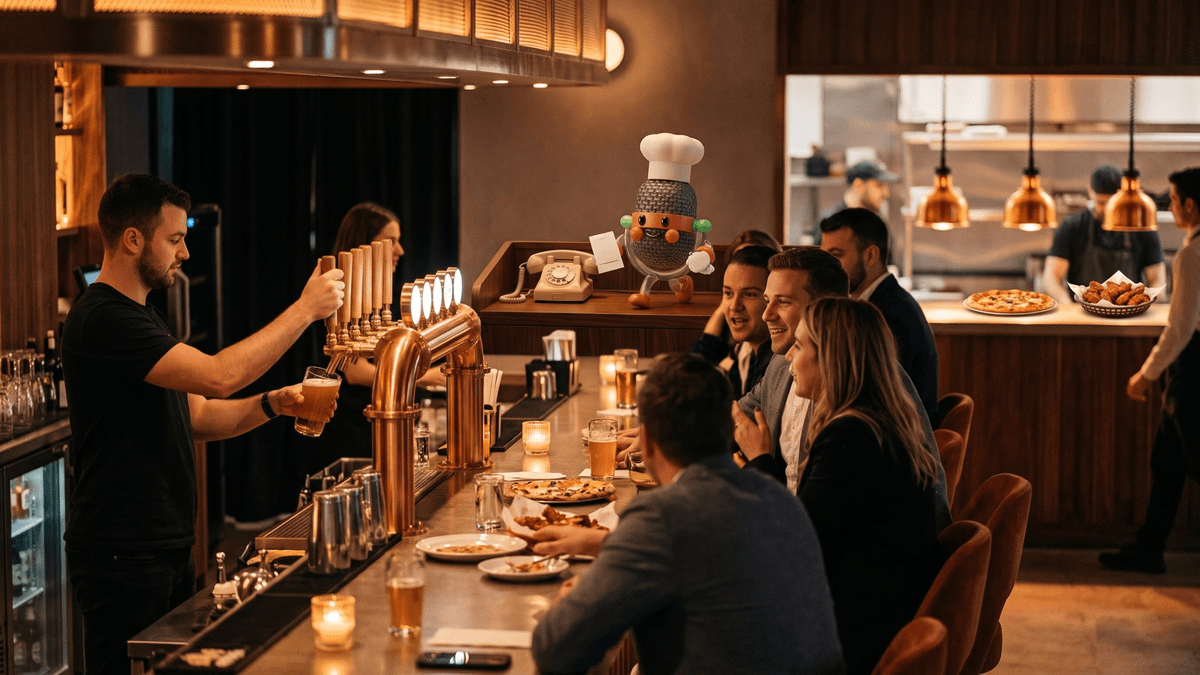
Because the person who owns the phone is pouring beer. At a brewery or bar with a kitchen, the phone usually sits behind the bar, so every takeout call pulls a bartender off a full rail. The fix is a clear standard for whoever answers, person or AI phone agent: know tonight's menu, build the order carefully, quote an honest ready time, take payment, and send one clean ticket to the kitchen.
Friday night, three deep, and the phone rings
You know this one. Friday, 7:40. Trivia starts at eight. The bartender is three deep and the rail is full. The kitchen is two people and a pizza oven.
The phone behind the bar rings.
"Hi, can I get two large pizzas for pickup? One half pepperoni, half sausage. Gluten-free crust on the other if you have it. And a dozen wings, half buffalo, half dry rub, ranch on the side."
Now somebody waits. Either the guest holding up a card at the bar waits while the bartender writes this down. Or the caller waits on hold, gives up, and orders somewhere else.
If the bartender takes it, the order lands on a scrap of paper or gets punched in fast. Is there gluten-free crust tonight? Did the dry rub run out an hour ago? Did anyone say when it would be ready? Did anyone take payment, or will the ticket sit there until the guest shows up, if they show up?
None of this is the bartender's fault. They are doing two jobs during the one hour when either job is already enough.
Why are brewery and bar kitchens a special case?
A brewery kitchen is a second business inside a bar. The menu is short. But the phone sits with the wrong team, and the rules change through the night.
There are a lot of these venues. In its 2025 craft brewing numbers, the Brewers Association counted 3,525 brewpubs and 3,784 taproom breweries in the United States, out of 9,578 craft breweries. It described taprooms and brewpubs as comparatively resilient and pointed to a continued shift toward drinking on site. Not all of them run a kitchen. The ones that do share the same phone problem.
Here is what makes their order calls different.
| What is different | What it means on an order call |
|---|---|
| Bar staff own the phone | Every call during a rush takes a bartender away from guests already in the building. |
| Short menu, heavy modifiers | Pizzas, wings and pretzels come with halves, crusts, sauces, sides and dips. A small menu can still make a long ticket. |
| Rotating taps and specials | The tap list and the weekly special change faster than any printed menu, and callers ask about both. |
| Items run out mid-shift | When the dough or the wings run out at 8:15, the phone has to know at 8:16. |
| Kitchen hours differ from bar hours | The bar may pour until midnight while the kitchen stops at 9:30. A caller at 9:45 needs a straight answer. |
| To-go beer is age-restricted | Cans and crowlers to go follow your licence and local rules, with an ID check where those rules require one. |
| Events spike calls | Trivia, live music, game nights and release days bring the busiest phone and the busiest bar at the same time. |
The call mix matters too. Across more than 1,000 calls at TastyVox venues, the mix varies by venue. At a pizza-led venue, most calls can be food orders. Where food is a side business, orders share the line with event questions, hours and directions. Count your own calls for a week before you decide what the phone needs to do.
What should an AI phone agent do on a brewery order call?
Answering is the low bar. Basic AI phone answering takes a message, or texts a menu link and leaves the order for someone else. A good AI phone agent takes the order under rules your venue has set, so the kitchen gets a ticket it can fire. Hold any phone agent, or staff script, to these six behaviours.
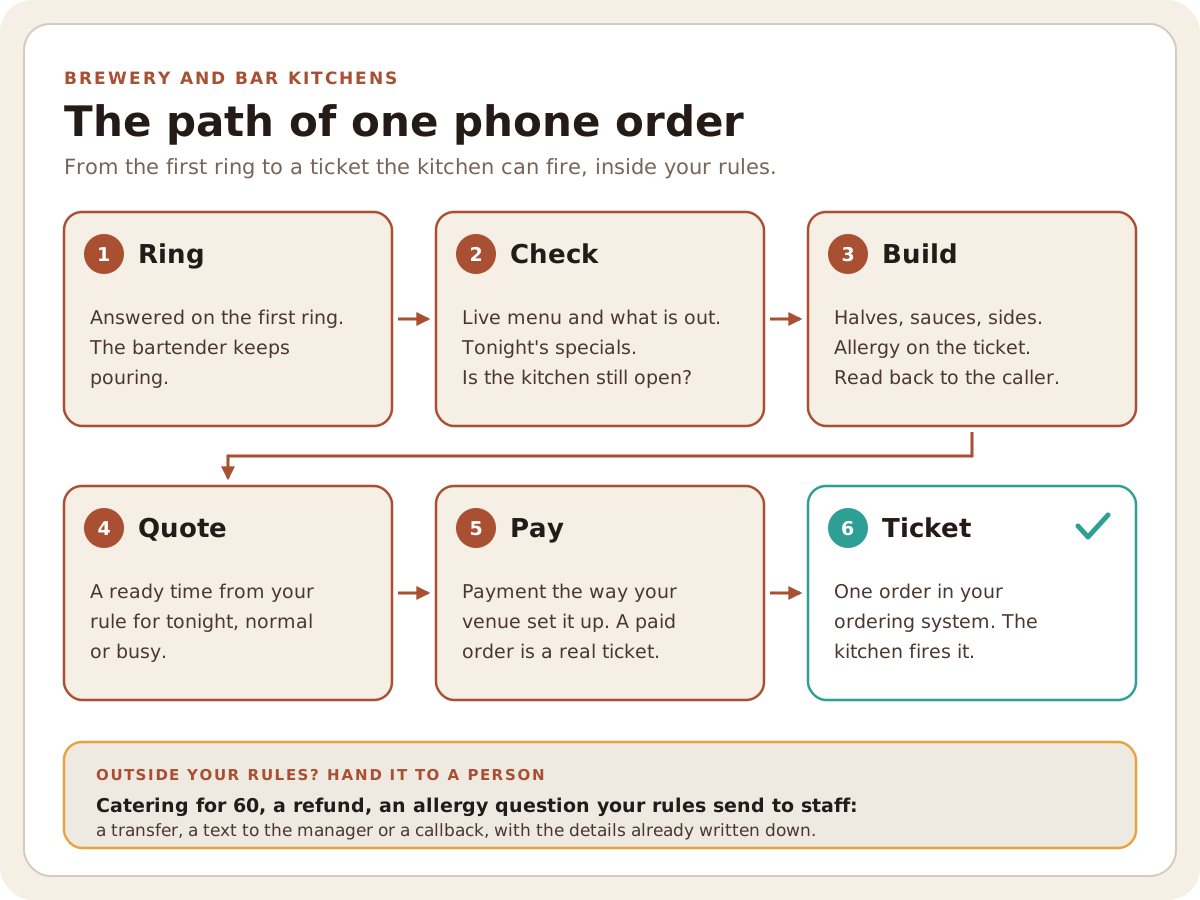
It knows tonight's menu, including what is out
The agent works from the live menu in your ordering system, not a PDF from last spring. When the kitchen marks the dry rub out, the next caller hears "We are out of dry rub tonight. Buffalo or garlic parmesan?" instead of placing an order the kitchen cannot make. It also knows the kitchen's last order time, separate from bar hours, and says so plainly when the kitchen has closed.
It builds the order carefully, modifiers and allergens included
Halves, crusts, sauces, sides, extra ranch. A good agent asks for each required choice, respects the limits, prices the add-ons and reads the order back before it is placed. Allergies get extra care. The agent puts the allergy on the ticket, never promises a dish is safe unless your kitchen has written that rule down, and brings in a person when your rule says to. Our guide to menus, modifiers and safe exceptions goes deeper.
It quotes a ready time the kitchen can hit
"Fifteen minutes" said to please a caller turns into a guest standing at the bar for forty. The agent quotes from your rule for tonight: a normal time, a busy time, and whatever the kitchen lead set when the ticket rail filled up. An honest 40 minutes beats a broken 20.
It takes payment so the ticket is real
An unpaid phone order is a guess. The agent takes payment the way your venue has set up, often a secure payment link by text, and the order fires under the rule you chose. The kitchen stops cooking for no-shows, and the bartender stops chasing cards at pickup.
It sends one order into your ordering system
The order goes into your ordering system, the same place counter and online orders go, so the kitchen sees one ticket in one queue. Your system stays the one source of truth for the menu, the prices and the order. No second tablet and no retyping from a text message. Our post on integrations and the source of truth explains why that matters.
It hands the call to a person when it leaves your rules
A catering order for 60. A refund for last week's order. A dish the kitchen has never made. An allergy question your rules send to a person. A good agent hands these over with the details already written down, by a transfer, a text to the manager or a callback, whichever your venue picked. Party and event calls need their own intake too.
Can a phone agent take orders for beer to go?
That depends on your licence, not on the software. Rules for alcohol to go vary by state, and sometimes by county or city, as the National Restaurant Association notes in its safe serving tips for alcohol to go. The National Alcohol Beverage Control Association keeps a state-level tracker of to-go and delivery policies. Neither one replaces your own licence or your local rules.
This is not legal advice. Check with your state or local licensing authority and write down what your venue may sell, in what containers, and how. Then hold the phone agent to that written rule.
- If you do not sell beer to go by phone, the agent says so and offers the food order.
- If you do, the agent offers only the formats your rule allows and tells the caller what to bring to pickup, such as a valid ID.
- The ID check happens at the counter, by a person. A phone call cannot confirm anyone's age.
- Anything outside the written rule goes to a person.
Pre-launch checklist for brewery phone orders
Before any phone agent takes its first order, settle these eight things with your kitchen lead and bar manager. Your team already makes most of these calls in their heads every night. Write them down.
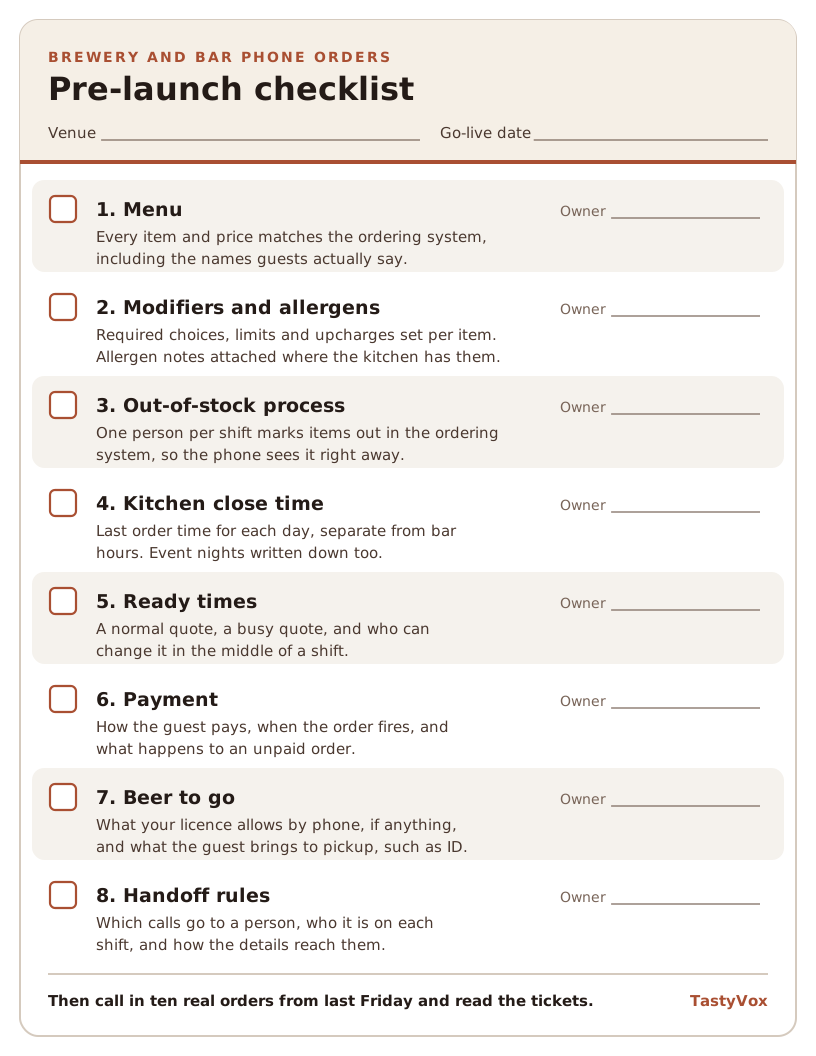
- Menu. Every item and price matches your ordering system, including the names guests actually say.
- Modifiers and allergens. Required choices, limits and upcharges are set for each item. Allergen notes are attached where your kitchen has them.
- Out of stock. One person per shift marks items out in the ordering system, so the phone sees it right away.
- Kitchen close time. The last order time for each day, written separately from bar hours, plus event nights.
- Ready times. A normal quote, a busy quote, and who can change it mid-shift.
- Payment. How the guest pays, when the order fires, and what happens to an unpaid order.
- Beer to go. What your licence allows by phone, if anything, and what the guest brings to pickup.
- Handoff rules. Which calls go to a person, who that person is on each shift, and how the details reach them.
Then test it. Take ten real orders from last Friday, including the messy ones, and call them in. Look at the tickets that reach the kitchen, not just the conversation.
What should you measure in the first week?
Do not judge a phone agent by how quiet the phone feels. Judge it by the tickets. Pull these at the end of week one.
| Measure | How to check it | What you want to see |
|---|---|---|
| Order calls that became orders | Compare order calls in the call log with phone orders in your ordering system | Most order calls end in a paid ticket. Read the ones that did not. |
| Paid when fired | Phone orders that were paid when the ticket fired | All of them, if that is your rule |
| Ready-time accuracy | Spot-check 20 pickups, quoted time against actual | Guests rarely waiting at the bar for food |
| Out-of-stock misses | Phone orders that included an item already marked out | Zero. One miss points to a gap in the out-of-stock process. |
| Ticket fixes | Phone tickets the kitchen had to correct, and why | Fewer each day, each one traced to a menu or rule gap |
| Handoffs and their reasons | Calls passed to a person, grouped by reason | Every handoff matches a rule you wrote |
| Bar interruptions | Ask the bartenders how often they grabbed the phone in a rush | Fewer than before, especially on event nights |
Fix gaps the same day. Most week-one problems come from menu data and missing rules, not from the agent's voice.
Where to start this week
You can tighten brewery phone orders before you buy anything. Write the eight checklist decisions on one page. Give one person per shift the job of marking items out. Post the kitchen's last order time next to the phone. Those three steps help a bartender, a host or a phone agent.
If you are comparing voice AI for bars, run your messiest Friday order through each option and read the ticket that reaches the kitchen. See also AI phone answering for activity venues, pricing models for venue phone AI and our page on phone agents for bars and breweries.
TastyVox pricing starts at $99 per location. Multi-location groups get custom pricing. There is no commission and no per-order cut. To hear a brewery order call from ring to ticket, book a fit call.
Last updated: November 18, 2026.
How this was researched
This guide uses the Brewers Association's 2025 industry figures, guidance on alcohol to go from the National Restaurant Association and the National Alcohol Beverage Control Association, and patterns from more than 1,000 calls at TastyVox venues. The phone-agent standard, the checklist and the week-one measures are editorial guidance, not customer results. Nothing in this article is legal advice.
Want to hear what this sounds like in practice?
Listen to a demo call with a real restaurant menu. No commitment, no sales pitch.
Frequently asked questions
How should a brewery handle phone orders when the bar is busy?
Take the phone off the bartender's plate. Either give one person the phone during rushes, or use an AI phone agent that takes the order under your rules. Whoever answers should know the live menu and what is out, quote a ready time from your rule for the night, take payment, and send one ticket into your ordering system.
Can an AI phone agent take food orders at a bar or brewery?
Yes, if it is set up with your live menu, modifiers, kitchen hours, ready-time rules and payment method, and if orders go into your ordering system rather than a separate screen. It should hand anything outside your rules, such as large catering orders or allergy questions your rules send to staff, to a person with the details written down.
What should happen when an item runs out mid-shift?
One person marks it out in the ordering system as soon as the kitchen calls it. A phone agent working from that live menu then stops offering it and suggests an alternative. If items are marked out on a whiteboard instead, the phone will keep selling them, so fix the process before launch.
Can a phone agent sell beer to go?
Only if your licence and local rules allow it, and only in the way they allow. Rules for alcohol to go vary by state and sometimes by county or city. Write your venue's rule down, have the agent follow it exactly, and keep the ID check with a person at pickup. This is not legal advice; check with your licensing authority.
Should brewery phone orders be paid before the kitchen starts them?
That is your call, but a paid order is a real order. Taking payment up front, often through a secure payment link by text, cuts cooking for no-shows and stops the bartender from chasing cards at pickup. Whatever you choose, write the rule down so every caller hears the same thing.
See how TastyVox sounds with your menu.
Book a 20-minute call and we'll walk through how it works for your specific restaurant.
Related reading