
What Callers Actually Want: Lessons From More Than 1,000 Venue Phone Calls
Key Takeaways
- The phone is a revenue line. Across more than 1,000 calls at TastyVox venues, food orders were as common as questions. Bookings and group events came next.
- Many questions are purchases in progress. "Do you have room for 12 on Saturday?" is the first line of a booking.
- Answer and forward is the low bar. A good AI phone agent finishes the job on the call, under rules your venue has approved.
- Count your own calls before you buy anything. One week with a tally sheet shows your real mix.
What do people call a venue about?
People call a venue to get something done at least as often as they call to ask something. Across more than 1,000 calls at TastyVox venues, food orders were as common as questions about hours, menu, location and prices. Bookings and group events came next. The phone is a revenue line, not an information desk.
Ask an owner what the phone is for, and you often hear the same list. What time do you close. Is there parking. Do you have anything gluten free.
So the phone gets treated like a nuisance. It sits by the host stand. Whoever is closest grabs it between other jobs. When it rings out, nobody worries much. It was probably someone asking about hours.
Then you listen to the calls, and a different picture shows up.
What did more than 1,000 venue phone calls show?
We sorted more than 1,000 calls at TastyVox venues by why the person called. The reasons come from call summaries, so treat the split as approximate.
Two reasons led, at similar volume: food orders, and questions about hours, menu, location and prices. Bookings and group events came next, at a bit under half the volume of either.
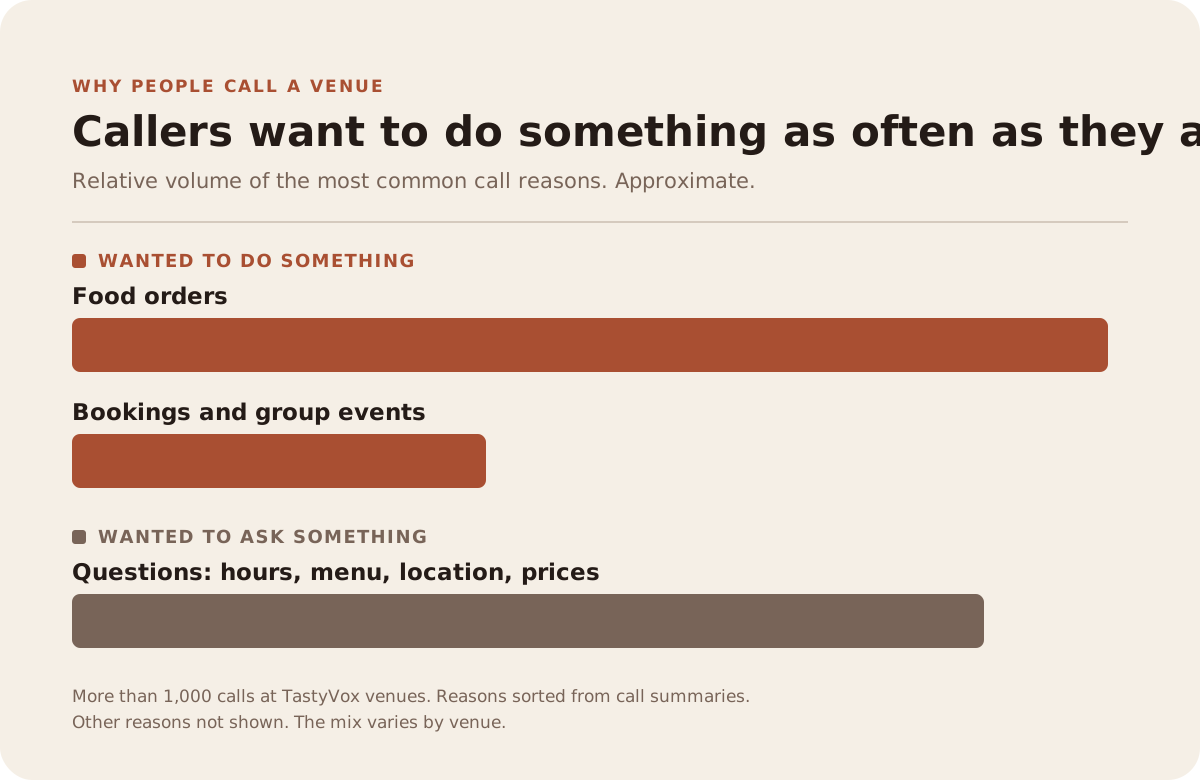
Group the reasons by what the caller wanted, and the pattern is plain. Orders plus bookings and group events add up to at least as many calls as questions. People call to get something done.
Your mix will differ. At a pizza-led venue, most calls can be food orders. A venue with lanes, bays or a private room will hear more booking and party calls. If you run an activity venue, our guide to AI phone answering for activity venues walks through each call type on a mixed line.
Is the phone still a real way to order and book?
Yes. Restaurant tech has spent years pushing guests toward apps and websites. The phone has not gone away.
Most restaurant phone call statistics you find online come from vendors. These two come from industry surveys.
In the National Restaurant Association's Off-Premises Restaurant Trends 2025 report, 39% of customers who used takeout, delivery or drive-thru in the past six months placed an order by phone. 17% named a phone call as their preferred way to order, rising to 20% among baby boomers.
Bookings follow the same habit. In the Association's State of the Restaurant Industry 2025 report, more than 9 in 10 full-service operators that take reservations let guests call to make one.
Both studies survey food and drink businesses, not activity venues. They still make one point clear. A real share of guests pick up the phone when they want to buy something, and some prefer it.
Why do owners think the phone is only for questions?
Because the calls you remember are not always the calls that matter most.
- Questions are frequent and short. Five "what time do you close" calls in a shift blur together into "the phone is all questions".
- Rung-out calls leave no record. You never learn what the caller who got no answer wanted. Some were questions. Some were orders, or a party of 20. Without a record, they all get filed under "probably hours".
- Many questions are purchases in progress. "Is the kitchen open until 11?" is often a late order. "Can a group of 12 come Saturday?" is a booking. Treat it as a question, and the sale ends at the answer.
- Staff answer what they can. On a busy night, the person on the phone gives the hours and hangs up. Nobody writes down that the caller was planning a birthday.
None of this is a staff problem. The phone was set up as an information line, so it gets run like one.
What should an AI phone agent do on these calls?
Finish the job on the call, under your rules. Answering and forwarding is the low bar.
A lot of AI phone answering works like a smarter voicemail. It picks up, answers common questions, texts a link and takes a message. That helps with hours and parking. It does little for the callers who wanted to do something.
A caller who rang to order chose the phone. Texting them a link sends them to the channel they did not pick. Here is the difference by call type.
| Why they called | Answer and forward | Finish the job (the standard) |
|---|---|---|
| Food order | Texts an online ordering link or takes a message | Takes the full order, reads it back and sends it into the POS and kitchen flow you already use |
| Booking | Texts a booking link | Makes the booking in your booking system, within rules you have approved, and says it is done only after that system accepts it |
| Group or event | Takes a name and number | Captures the details, checks your minimums and capacity, and drafts a proposal for your team to approve |
| Question | Answers it | Answers from your information, then offers the next step: "We're open until 11. Want me to put that order in?" |
Three rules sit under every row.
- Your systems stay the source of truth. Orders land in your POS. Bookings live in your booking system. The agent writes into them. It does not keep a side list.
- It acts only within what you have authorised. Party sizes, times, packages and prices. Anything outside those goes to a person.
- It knows when to hand off. Complaints, safety issues, refunds and exceptions go to a person, with the details already written down. Our guide on when to transfer a call to a person covers how to test this.
Group calls deserve extra care, because they carry the biggest checks. Our guide to holiday party and group booking calls lists the seven details to capture before a manager calls back.
How do you audit your own calls in one week?
You do not need software to see your own mix. You need one week and a sheet of paper.
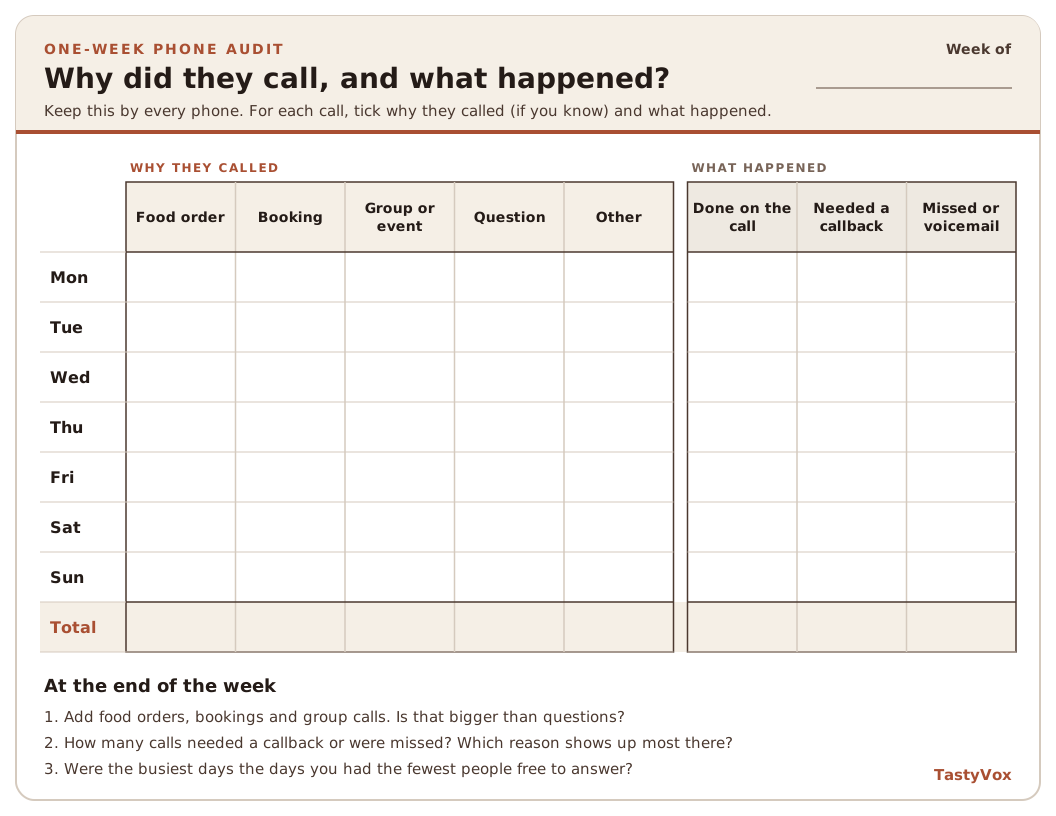
- Pick a normal week. Include a Friday and a Saturday. Skip a holiday week unless that is the season you are planning for.
- Put the sheet by every phone. Host stand, bar and office.
- Tick two boxes per call. One for why they called, one for what happened. If a call rang out with no message, tick only Missed.
- Check the call log and voicemail each day. Add missed calls from the log. Listen to messages and sort them by reason.
- Total it at the end of the week. Then answer three questions. Are food orders, bookings and group calls together bigger than questions? Which reason shows up most under callback and missed? Were your busiest phone days the days with the fewest people free to answer?
If doing outweighs asking on your sheet, a tool that only answers questions is solving the smaller problem.
What should you require from any AI phone agent?
If you are shopping for voice AI for your venue, take your tally into every demo. Then hold the vendor to this list.
- It finishes the job on the call. Orders, bookings and group inquiries end with something done, not a link and a goodbye.
- It works inside your rules. You decide what it can do on its own. Everything else goes to a person.
- It writes into your systems. A test order should reach the kitchen. A test booking should appear in your booking system.
- It never overstates. A time is not booked until your booking system says so. A party date is not held until your team approves it.
- It reports by reason and outcome. You should be able to rebuild your tally from its call log, without a clipboard.
- Its pricing does not punish your best nights. Compare flat fee, per minute and per order models in our guide to venue phone AI pricing models.
The phone is a revenue line. Judge any phone agent by what it gets done, not by how many calls it picks up.
TastyVox pricing starts at $99 per location. Multi-location groups get custom pricing. There is no commission and no per-order cut. To hear how a phone agent handles a call mix like yours, book a fit call.
Last updated: November 16, 2026.
How this was researched
This post draws on more than 1,000 calls at TastyVox venues, with call reasons sorted from call summaries, so the split is approximate and varies by venue. Phone ordering and reservation figures come from two National Restaurant Association reports, Off-Premises Restaurant Trends 2025 and State of the Restaurant Industry 2025, which survey food and drink businesses and their customers, not activity venues. The phone agent standard and the one-week tally are editorial guidance.
Want to hear what this sounds like in practice?
Listen to a demo call with a real restaurant menu. No commitment, no sales pitch.
Frequently asked questions
What do people call restaurants and venues about most?
Across more than 1,000 calls at TastyVox venues, the two most common reasons were food orders and questions about hours, menu, location and prices, at similar volume. Bookings and group events came next, at a bit under half the volume of either. The mix varies by venue. At a pizza-led venue, most calls can be food orders.
Do people still order food by phone?
Yes. In the National Restaurant Association's Off-Premises Restaurant Trends 2025 report, 39% of customers who used takeout, delivery or drive-thru in the past six months placed an order by phone. 17% said a phone call was their preferred way to order.
How can I find out why customers call my venue?
Run a one-week tally. Put a sheet by every phone and tick why each person called and what happened. Add missed calls from your call log and voicemail. At the end of the week, compare the calls that wanted something done with the calls that only asked a question.
What is the difference between AI phone answering and an AI phone agent?
AI phone answering often means picking up every call, answering common questions, and taking messages or texting links. An AI phone agent should go further. It takes the order into your POS, makes the booking in your booking system within your rules, and drafts group proposals for your team to approve.
Should an AI phone agent make bookings or just text a link?
If the caller chose the phone, a good agent should make the booking on the call, within rules your venue has approved, in your own booking system. It should never tell the caller a time is theirs until that system has accepted it. Requests outside your rules go to a person.
See how TastyVox sounds with your menu.
Book a 20-minute call and we'll walk through how it works for your specific restaurant.